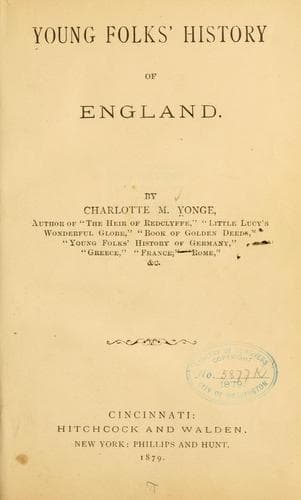
Young Folks' History of EnglandYonge, Charlotte M. (Charlotte Mary)
History
Young Folks' History of England
Yonge, Charlotte M. (Charlotte Mary)
Great Britain -- History -- Juvenile literature
James was soon obliged to leave Ireland, and his friends there were
severely punished. In the meantime, William was fighting the French
in Holland--as he had done nearly all his life--while Mary governed
the kingdom at home. She was a handsome, stately lady, and was much
respected; and there was great grief when she died of the small-pox,
never having had any children. It was settled upon this that William
should go on reigning as long as he lived, and then that Princess Anne
should be queen; and if she left no children, that the next after
her should be the youngest daughter of Elizabeth, daughter of James
I. Her name was Sophia, and she was married to Ernest of Brunswick,
Elector of Hanover. It was also settled that no Roman Catholic, nor
even anyone who married a Roman Catholic, could ever be on the English
throne.
Most of the Tories disliked this Act of Settlement; and nobody had
much love for King William, who was a thin, spare man, with a large,
hooked nose, and very rough, sharp manners--perhaps the more sharp
because he was never in good health, and suffered terribly from the
asthma. However, he managed to keep all the countries under him in
good order, and he was very active, and always at war with the French.
Towards the end of his reign a fresh quarrel began, in which all
Europe took part. The King of Spain died without children, and the
question was who should reign after him. The King of France had
married one sister of this king, and the Emperor of Germany was the
son of her aunt. One wanted to make his grandson king of Spain, the
other his son, and so there was a great war. William III. took part
against the French--as he had always been their enemy; but just as
the war was going to begin, as he was riding near his palace of Hampton
Court, his horse trod into a mole-hill, and he fell, breaking his
collar bone; and this hurt his weak chest so much that he died in a
few days, in the year 1702. The Jacobites were very glad to be rid
of him, and used to drink the health of the "little gentleman in a
black velvet coat," meaning the mole which had caused his death.
CHAPTER XL.
ANNE. A.D. 1702--1714.
Public-domain text, read in full here on John Shaqi.
Reviews
Reviews
No reviews yet
Be the first to share your thoughts on this work.
Elsewhere in the archive
Join the Discussion
Join the discussion
Sign in to leave a comment or review.
Sign InorCreate an account