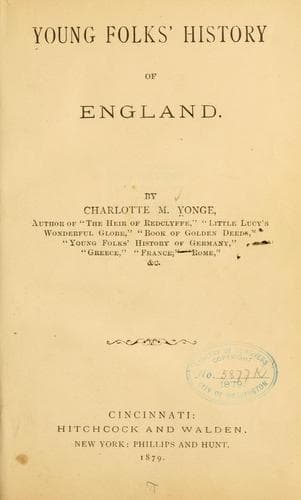
Young Folks' History of EnglandYonge, Charlotte M. (Charlotte Mary)
History
Young Folks' History of England
Yonge, Charlotte M. (Charlotte Mary)
Great Britain -- History -- Juvenile literature
The English army had come back by this time, and the Scots were
followed closely, getting more sad and forlorn, and losing men in every
day's march, till at last, after they had reached Scotland again, they
made a stand against the English under the king's second son, William,
Duke of Cumberland, at the heath of Culloden. There they were entirely
routed, and the prince had to fly, and hide himself in strange places
and disguises, much as his great uncle, Charles II., had done before
him. A young lady named Flora Macdonald took him from one of the
Western Isles to another in a boat as her Irish maid, Betty Bourke;
and, at another time, he was his in a sort of bower, called the cage,
woven of branches of trees on a hill side, where he lived with three
Highlanders, who used to go out by turns to get food. One of them
once brought him a piece of ginger-bread as a treat--for they loved
him heartily for being patient, cheerful, and thankful for all they
did for him; and when at last he found a way of reaching France, and
shook hands with them on bidding the farewell, one of them tied up
his right hand, and vowed that no meaner person should ever touch it.
The Empress Maria Theresa, of Germany, had a long war with Frederick,
King of Prussia, who was nephew to George II., and a very clever and
brave man, who made his little kingdom of Prussia very warlike and
brave. But he was not a very good man, and these were sad times among
the great people, for few of them thought much about being good: and
there were clever Frenchmen who laughed at all religion. You know
one of the Psalms, "The fool hath said in his heart, there is no God."
There were a great many such fools at that time, and their ways,
together with the selfishness of the nobles, soon brought terrible
times to France, and all the countries round.
The wars under George II. were by sea as well as by land: and,
likewise, in the distant countries where Englishmen, on the one hand,
and Frenchmen, on the other, had made those new homes that we call
colonies. In North America, both English and French had large
settlements; and when the kings at home were at war, there were
likewise battles in these distant parts, and the Indians were stirred
up to take part with the one side or the other. They used to attack
the homes of the settlers, burn them, kill and torment the men, and
keep the children to bring up among their own. The English had, in
general, the advantage, especially in Canada, where the brave young
General Wolfe led an attack, on the very early morning, to the Heights
of Abraham, close to the town of Quebec. He was struck down by a
shot early in the fight, and lay on the ground with a few officers
round him. "They run, they run!" he heard them cry. "Who run?" he
asked. "The French run." "Then I die happy," he said; and it was
by this battle that England won Lower Canada, with many French
inhabitants, whose descendants still speak their old language.
Public-domain text, read in full here on John Shaqi.
Reviews
Reviews
No reviews yet
Be the first to share your thoughts on this work.
Elsewhere in the archive
Join the Discussion
Join the discussion
Sign in to leave a comment or review.
Sign InorCreate an account