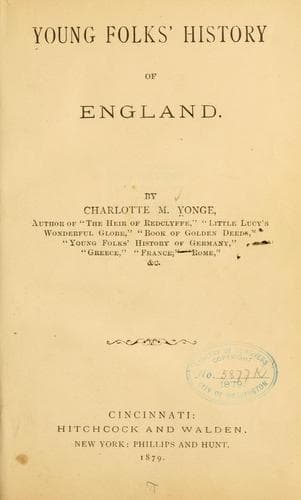
Young Folks' History of EnglandYonge, Charlotte M. (Charlotte Mary)
History
Young Folks' History of England
Yonge, Charlotte M. (Charlotte Mary)
Great Britain -- History -- Juvenile literature
In the East Indies, too, there was much fighting. The English and
French both had merchants there; and these had native soldiers to
guard them, and made friends with the native princes. When these
princes quarreled they helped them, and so obtained a larger footing.
But in this reign the English power was nearly ended in a very sad
way. An Indian army came suddenly down on Calcutta. Many English
got on board the ships, but those who could not--146 in number--were
shut up all night in a small room, in the hottest time of the year,
and they were so crushed together and suffocated by the heat that,
when the morning came, there were only twenty-three of them alive.
This dreadful place was known as the Black Hole of Calcutta. The
next year Calcutta was won back again; and the English, under Colonel
Clive, gained so much ground that the French had no power left in
India, and the English could go on obtaining more and more land,
riches and power.
George II. had lost his eldest son, Frederick, Prince of Wales, and
his lively and clever wife, Queen Caroline, many years before his
death. His chief ministers were, first, Sir Robert Walpole, and
afterwards the Earl of Chatham--able men, who knew how to manage the
country through all these wars. The king died at last, quite suddenly
when sixty-eight years old, in the year 1760.
CHAPTER XLIII.
GEORGE III. A.D. 1760--1785.
After George II. reigned his grandson, George III., the son of
Frederick, Prince of Wales, who had died before his father. The
Princess of Wales was a good woman, who tried to bring up her
children well; and George III. was a dutiful son to her, and a good,
faithful man--always caring more to do right than for anything else.
He had been born in England, and did not feel as if Hanover were his
home, as his father and grandfather had done, but loved England, and
English people, and ways. When he was at Windsor, he used to ride or
walk about like a country squire, and he had a ruddy, hearty face and
manner, that made him sometimes be called Farmer George; and he had
an odd way of saying "What? what?" when he was spoken to, which made
him be laughed at; but he was as good and true as any man who ever
lived: and when he thought a thing was right, he was as firm as a
rock in holding to it. He married a German princess named Charlotte,
and they did their utmost to make all those about them good. They
had a very large family--no less than fourteen children--and some old
people still remember what a beautiful sight it was when, after church
on Sunday, the king and queen and their children used to walk up and
down the stately terrace at Windsor Castle, with a band playing, and
everyone who was respectably dressed allowed to come in and look at
them.
Public-domain text, read in full here on John Shaqi.
Reviews
Reviews
No reviews yet
Be the first to share your thoughts on this work.
Elsewhere in the archive
Join the Discussion
Join the discussion
Sign in to leave a comment or review.
Sign InorCreate an account