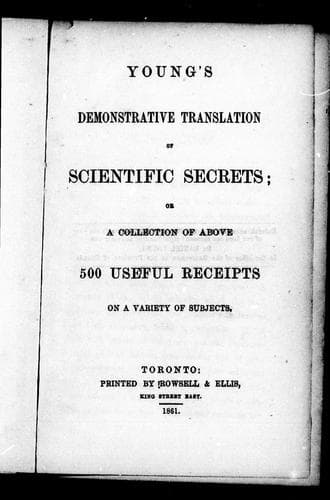
Young's Demonstrative Translation of Scientific Secrets: Or, A Collection of Above 500 Useful Receipts on a Variety of SubjectsYoung, Daniel
Science
Young's Demonstrative Translation of Scientific Secrets: Or, A Collection of Above 500 Useful Receipts on a Variety of Subjects
Young, Daniel
Formulas, recipes, etc.; Science -- Methodology
Take good clear white course sand, 3 parts; refined solton, 1 part;
fosterine, 1 part; rock salt 1 part; borax, 1 part; mix all
together. Take 2 pieces of cast iron, heat them in a moderate
charcoal fire, occasionally taking them out while heating, and
dipping them into the composition, until they are of a proper heat
to weld, then at once lay them on the anvil, and gently hammer them
together, and if done carefully by one who understands welding iron,
you will have them nicely welded together. One man prefers heating
the metal, then cooling it in the water of common beans, and heating
it again for welding.
137. CAST IRON CEMENT
Take of clean borings or turning of cast iron, 16 parts; of
sal-ammoniac, 2 parts; and flour of sulphur, 1 part; mix them well
together on a mortar, and keep them dry. When required for use,
take 1 part of the mixture, and 20 parts of clean borings, mix
thoroughly, and add a sufficient quantity of water. Note.--A little
grindstone added improves the cement.
138. CASE HARDENING
This is the conversion of the surface of wrought iron into steel,
for the purpose of adapting it to receive a polish, or to bear
friction, &c. The best method in the world of effecting this is by
heating the iron to cherry red in a close vessel, in contact with
carbonacious material, and then plunging it into cold water. Bones,
leather, hoofs, and horns of animals, are best for this purpose,
after having been burnt or roasted, so that they can be pulverized.
Soot is very frequently used; it answers, but not so well.
139. TO SOFTEN IRON OR STEEL
Either of the following simple methods will make iron or steel as
soft as lead: 1. Anoint it all over with tallow, temper it in a
gentle charcoal fire, and let it cool of itself. 2. Take a little
clay, cover your iron with it, temper in a charcoal fire. 3. When
the iron or steel is red hot, strew hellebore on it. 4. Quench the
iron or steel in the juice, or water, of common beans.
140. SOLDER FOR LEAD
Melt 1 part of block tin, and when in a state of fusion, add 2 parts
of lead; if a small quantity of this, when melted, is poured upon
the table, there will, if it be good, arise little bright stars upon
it. Resin should be used with this solder.
141. SOLDER FOR TIN
Take 4 parts of pewter, 1 of tin, and 1 of bismuth, melt them
together, and run them into thin slips. Resin is also employed in
using this solder.
142. SOLDER FOR IRON
The best solder for iron is good tough brass, with a little borax.
143. SOLDER FOR COPPER
Take of brass, 6 parts; zinc, 1 part; tin, 1 part; melt all
together, mix well, and pour out to cool.
144. SOLDER FOR STEEL JOINTS
Silver, 19 parts; copper, 1 part; brass, 2 parts; melt all together.
145. HARD SOLDER
Fuse together 2 parts of copper, and 1 of zinc.
146. SOLDER FOR SILVER
Fuse together 5 parts of silver, and 1 part of brass.
147. GOLD SOLDER No. 1
Take of gold, 4 parts; silver, 3 parts; copper 1 part; and zinc,
1 part.
148. GOLD SOLDER No. 2
Public-domain text, read in full here on John Shaqi.
Reviews
Reviews
No reviews yet
Be the first to share your thoughts on this work.
Join the Discussion
Join the discussion
Sign in to leave a comment or review.
Sign InorCreate an account