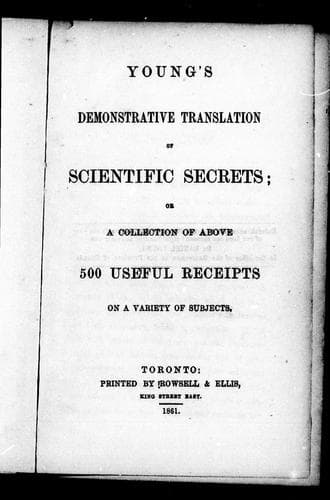
Young's Demonstrative Translation of Scientific Secrets: Or, A Collection of Above 500 Useful Receipts on a Variety of SubjectsYoung, Daniel
Science
Young's Demonstrative Translation of Scientific Secrets: Or, A Collection of Above 500 Useful Receipts on a Variety of Subjects
Young, Daniel
Formulas, recipes, etc.; Science -- Methodology
Another, and perhaps better method of preparing gold powder is to
heat a prepared amalgam of gold in a clean open crucible, (an
amalgam of any metal is formed by a mixture of quicksilver with
that metal) continuing a very strong heat till all the mercury has
evaporated, stirring the amalgam all the while with a glass rod;
when the mercury has entirely left the gold, grind the remainder in
a Wedgewood's mortar, with a little water, and when dried it will be
fit for use. The subliming the mercury is, however, a process
injurious to the health.
171. COLOUR HEIGHTENING COMPOSITIONS
For yellow gold, dissolve in water 6 ozs. of saltpetre, 2 ozs. of
copperas, 1 oz. of white vitriol, and 1 oz. of alum. If wanted
redder, add a small portion of blue vitriol.
172. FOR GREEN GOLD
Dissolve in water a mixture consisting of 1-1/2 oz. of saltpetre;
vitriol and sal-ammoniac, 1-1/4 oz. of each, and 1 oz. verdigris.
173. FOR RED GOLD
Take 1-1/2 oz. of red ochre in fine powder, the same quantity of
calcined verdigris, 1/2 oz. of calcined borax, and 4 oz. of melted
yellow wax; the verdigris must be calcined, or else, by the heat
applied in melting the wax, the vinegar becomes so concentrated as
to corrode the surface, and make it appear speckled. These last
three are colours for heightening compositions.
174. MOSAIC GOLD
Mosaic gold, or aurum mosaicum, is used for inferior articles. It
is prepared in the following manner: 1 lb. of tin is melted in a
crucible, and 1/2 lb. of purified quicksilver added to it; when this
mixture is cold, it is reduced to powder, and ground with 1/2 lb.
of sal-ammoniac, and 7 ozs. of flower of sulphur, till the whole
is thoroughly mixed; they are then calcined in a mattrass, and the
sublimation of the other ingredients leaves the tin converted into
the aurum mosaicum, which is found at the bottom of the glass, like
a mass of bright flakey gold powder. Should any black or discoloured
particles appear, they must be removed. The sal-ammoniac used
here must be very white and clear, and the mercury quite pure and
unadulterated. When a shade of deeper red is required, it can easily
be obtained by grinding a very small quantity of red lead along with
the above materials.
175. DUTCH OR GERMAN GOLD
A gilding powder is sometimes made from Dutch gold, which is sold in
books at a very low price. This is treated in the same way as the
real gold leaf in making the true gold powder. It is necessary, when
this inferior powder is used, to cover the gilding with a coat of
clear varnish, otherwise it soon loses its metallic appearance. The
same remark applies, though to a less degree, to Mosaic gilding.
176. COPPER POWDER
Public-domain text, read in full here on John Shaqi.
Reviews
Reviews
No reviews yet
Be the first to share your thoughts on this work.
Join the Discussion
Join the discussion
Sign in to leave a comment or review.
Sign InorCreate an account