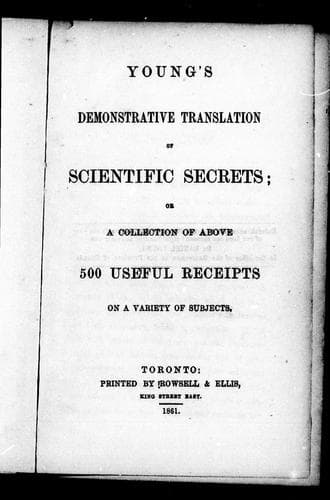
Young's Demonstrative Translation of Scientific Secrets: Or, A Collection of Above 500 Useful Receipts on a Variety of SubjectsYoung, Daniel
Science
Young's Demonstrative Translation of Scientific Secrets: Or, A Collection of Above 500 Useful Receipts on a Variety of Subjects
Young, Daniel
Formulas, recipes, etc.; Science -- Methodology
This may be effected by a process somewhat differing from the above,
Prussian blue, patent yellow, raw amber, lamp-black, and pipe clay
are ground separately with water on a stone, and as much of them as
will make a good colour put into a small vessel three-fourths full
of size. This mixture is found to succeed best on using about half
as much more pipe clay as of any of the other ingredients. The wood
being previously cleaned and smoothed, and coated with a mixture of
clean size and lamp-black, receives a new coating with the above
compound twice successively, having allowed the first to dry.
Afterwards the bronze powder is to be laid on with a pencil, and the
whole burnished or cleaned anew, observing to repair the parts which
may be injured by this operation; next, the work must be coated over
with a thin lather of castile soap, which will take off the glare of
the burnishing, and afterwards be carefully rubbed with a woollen
cloth. The superfluous powder may be rubbed off when dry.
181. IN BRONZING IRON
The subject should be heated to a greater degree than the hand can
bear; and German gold, mixed with a small quantity of spirit of wine
varnish, spread over it with a pencil; should the iron be already
polished, you must heat it well and moisten it with a linen rag
dipped in vinegar.
182. BRONZING CASTS OF PLASTER OF PARIS
There is a method of bronzing casts of plaster of Paris analogous to
that which we have above given for bronzing wood, but it is not in
much repute. Such figures may be beautifully varnished by means of
Dr. John's varnish, receipt No. 178. Casts of plaster of Paris may be
made by receipt No. 167.
183. SHELL-LAC VARNISH
Dissolve in an iron kettle, one part of pearl-ash in about 8 parts
of water; add one part of shell-lac, and heat the whole to
ebullition. When the lac is dissolved, cool the solution, and
impregnate it with chlorine, till the lac is all precipitated.
The precipitate is white, but its colour deepens by washing and
consolidation; dissolved in alcohol, lac bleached by the above
process yields a varnish which is as free from colour as any copal
varnish.
184. CHLORINE FOR SHELL-LAC VARNISH
This may be formed by mixing intimately eight parts of common salt,
and three parts of the black oxide of manganese in powder; put this
mixture into a retort, then pour four parts of sulphuric acid,
diluted with an equal weight of water, and afterwards allowed to
cool upon the salt and manganese; the gas will then be immediately
liberated, and the operation may be quickened by a moderate heat. A
tube leading from the mouth of the retort must be passed into the
resinous solution, where the gas will be absorbed, and the lac
precipitated.
185. SHELL-LAC VARNISHES OF VARIOUS COLOURS
Public-domain text, read in full here on John Shaqi.
Reviews
Reviews
No reviews yet
Be the first to share your thoughts on this work.
Join the Discussion
Join the discussion
Sign in to leave a comment or review.
Sign InorCreate an account