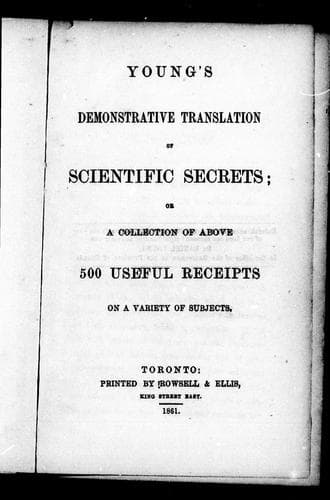
Young's Demonstrative Translation of Scientific Secrets: Or, A Collection of Above 500 Useful Receipts on a Variety of SubjectsYoung, Daniel
Science
Young's Demonstrative Translation of Scientific Secrets: Or, A Collection of Above 500 Useful Receipts on a Variety of Subjects
Young, Daniel
Formulas, recipes, etc.; Science -- Methodology
Oxide of cobalt, 1 part; oxide of zinc, 3 or 4 parts; flux No. 3, 6
parts; melt and pour out. If it is not sufficiently green, increase
the zinc and flux.
231. AZURE BLUE
Oxide of cobalt, 1 part; oxide of zinc, 2 parts; flux No. 2, 8 parts;
melt them together.
232. DEEP AZURE BLUE
Oxide of cobalt, 1 part; oxide of zinc, 2 parts; flux No. 2, 5 parts.
The beauty of this colour depends on the proportion of flux. As
little as possible is to be used; it must, however, be brilliant.
Sometimes less is used than the proportion indicated.
233. SKY BLUE
Oxide of cobalt, 1 part; oxide of zinc, 2 parts; flux No. 2, 12
parts; pound up, melt, and pour out.
234. EMERALD GREEN
Oxide of copper, 1 part; antimonic acid, 10 parts; flux No. 1, 30
parts; pulverize together, and melt.
235. BLUEISH GREEN
Green oxide of chromium, 1 part; oxide of cobalt, 2 parts;
triturate, and melt at a high heat. The product is a button slightly
melted, from which is removed the portion in contact with the
crucible. This button is pounded up, and three parts of flux No. 3,
for one of the button, are added to it.
236. GRASS GREEN
Green oxide of chromium 1 part, flux No. 3, 3 parts, triturate and
melt.
237. DEEP YELLOW
Antimonic acid 2 parts, subsulphate of iron 1 part, flux No. 1, 10
parts; melt and pour out. The subsulphate of iron may be increased a
little, the proportions of flux vary.
238. JONQUILLE YELLOW FOR FLOWERS
Litharge 18 parts, sand 6 parts. The product of the calcination of
equal parts of lead and tin 2 parts, carbonate of soda 1 part,
antimonic acid 1 part, rub together, or triturate, and melt.
239. WAX YELLOW
Litharge 18 parts, sand 4 parts, oxide of antimony 2 parts, sienna
earth 2 parts; melt. If it is too deep the proportion of sienna
earth may be decreased.
240. ORANGE YELLOW
Chromate of lead 1 part, minium 3 parts.
241. BRICK RED
Yellow No. 240, 12 parts; red oxide of iron, 1 part.
242. DEEP BLOOD RED
Subsulphate of iron, calcined in a muffle until it becomes a
beautiful capucine red, 1 part; flux No. 2, 3 parts; mix without
melting.
243. BROWN YELLOW OCHRE
Yellow ochre No. 244, 10 parts; sienna earth, 1 part; triturate
without melting.
244. DEEP YELLOW OCHRE--CALLED YELLOW BROWN
Subsulphate of iron, 1 part; oxide of zinc, 1 part; flux No. 2, 5
parts; triturate without melting.
245. PURE PURPLE
The purple powder of Cassius mixed while moist with flux No. 3, and
sometimes a little chloride of silver previously melted with flux
No. 3. If the purple, when prepared, does not melt sufficiently easy,
some flux may be added when it is dry.
246. DEEP VIOLET
The purple of Cassius, in place of flux No. 3, flux No. 1 is mixed
with it. Sometimes a little of blue No. 233 is added.
247. FLESH RED
Public-domain text, read in full here on John Shaqi.
Reviews
Reviews
No reviews yet
Be the first to share your thoughts on this work.
Join the Discussion
Join the discussion
Sign in to leave a comment or review.
Sign InorCreate an account