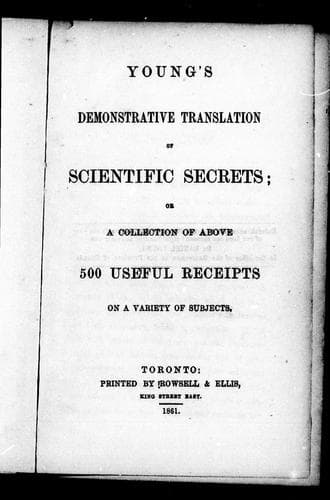
Young's Demonstrative Translation of Scientific Secrets: Or, A Collection of Above 500 Useful Receipts on a Variety of SubjectsYoung, Daniel
Science
Young's Demonstrative Translation of Scientific Secrets: Or, A Collection of Above 500 Useful Receipts on a Variety of Subjects
Young, Daniel
Formulas, recipes, etc.; Science -- Methodology
When the plating is as heavy as you wish, polish it with a mixture
of chalk and alcohol, or of chalk alone, applied with a fine brush,
or else a bit of chamois leather or rag.
If you wish to put on a very heavy coat of silver or gold, instead
of using zinc alone as a battery, use the following, attach a piece
of copper to one end of an iron wire about ten inches long, and a
piece of zinc to the other end, and place both zinc and copper in
contact with the article being silvered or gilded.
531. USING FRENCH POLISH
There is a mode of using shell-lac varnish which is sometimes
denominated the German, but more commonly the French mode. It merits
to be generally known, as the process is easy and economical, and
the effect beautiful. It has been much employed by cabinet and
musical instrument makers, but is not yet so extensively practised
as it merits to be. The varnish is applied by means of what is
called a rubber, made by rolling up a piece of thick woollen cloth,
which has been torn off so as to have a soft, elastic edge. The
varnish, put into a narrow-mouthed bottle, is applied to the middle
of the flat face of the rubber by laying the rubber on mouth of the
bottle and quickly shaking the varnish at once, as the rubber will
thus imbibe a sufficient quantity to varnish a considerable extent
of surface. The rubber is then enclosed in a soft linen cloth
doubled, the remainder of the cloth being gathered together at the
back of the rubber to form a handle to hold it by; and the face of
the linen cloth must be moistened with a little raw linseed oil,
which may either be coloured with alkanet root or not, applied with
the finger to the middle of it. The work to be varnished should
be placed opposite to the light, in order that the effect of the
polishing may be better seen, and a surface of from ten to eight
feet square may be varnished at once. The rubber must be quickly and
lightly rubbed upon the surface of the article to be varnished, and
the rubbing continued until the varnish becomes nearly dry. The coil
of woollen cloth must then be again wetted with the varnish, (no
more oil need be applied to the surface of the linen cloth,) and
the rubbing renewed till the varnish becomes nearly dry as before;
a third coat must be applied in the same manner, then a fourth with
a little oil, which must be followed by two others without oil,
as before. You proceed thus until the varnish has acquired some
thickness, which will be after a few repetitions of the series.
Apply then a little alcohol to the inside of the linen cloth, and
wet the coil with the varnish; after which, rub very quickly,
lightly, and uniformly, over every part of the varnished surface,
which will tend to make it even, and very much conduce to its
polish. The linen cloth must now be wetted with a little alcohol and
oil, without varnish; and the varnished surface being rubbed over,
with the precautions last mentioned, until it is nearly dry, the
effect of the operation will be seen.
Public-domain text, read in full here on John Shaqi.
Reviews
Reviews
No reviews yet
Be the first to share your thoughts on this work.
Elsewhere in the archive
Join the Discussion
Join the discussion
Sign in to leave a comment or review.
Sign InorCreate an account