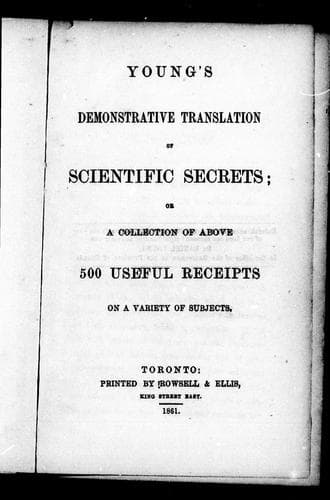
Young's Demonstrative Translation of Scientific Secrets: Or, A Collection of Above 500 Useful Receipts on a Variety of SubjectsYoung, Daniel
Science
Young's Demonstrative Translation of Scientific Secrets: Or, A Collection of Above 500 Useful Receipts on a Variety of Subjects
Young, Daniel
Formulas, recipes, etc.; Science -- Methodology
If it be found not complete,
the process must be continued, with the introduction of alcohol in
its turn as directed before, until the surface becomes smooth and
of a beautiful lustre. The preceding process is that in general use;
but Dr. Jones recommends, in the Franklin Journal, a rubber of a
different sort, as well as a simpler mode of employing it. He takes
a piece of thick woollen cloth, six or eight inches in diameter, and
upon one side of this pours a teaspoonful of the varnish; he then
collects the edges together, so as to enclose the varnish in the
cloth and form a handle by which to hold it: this is finally covered
with a piece of oiled linen cloth, and the rubber is ready for use.
More varnish is added as often as it is required; and when it
becomes occasionally too thick to ooze through, a little alcohol is
poured into the cloth. Some difficulties may be at first experienced
in performing this process; but Dr. Jones states that a very little
practice will enable any handy person to surmount them. The peculiar
advantage said to attend it is, that a beautiful polish may be at
once obtained by a continued application of the rubber in this way;
while, according to the method previously described, successive
coats of varnish, which require considerable time to dry, must be
used, and a great deal of additional trouble incurred. In varnishing
recesses or carved work, where parts of the surface are difficult to
reach with the rubber, a spirit varnish, made with or without lac of
the usual gum resins, and considerably thicker than that used for
the rest of the work, may be applied to those parts with a brush or
hair pencil.
532. LACQUER FOR BRASS
Seed-lac, 6 ozs.; amber or copal, ground on porphyry or very
clean marble, 2 ozs.; dragon's blood, 40 grains; extract of red
sandal-wood, 30 grains; oriental saffron, 36 grains; pounded glass,
4 ozs.; very pure alcohol, 40 ozs. Articles, or ornaments of brass,
to which this varnish is to be applied, should be exposed to a
gentle heat and then dipped into the varnish. Two or three coatings
may be thus applied, if necessary. Articles varnished in this manner
may be cleaned with water and a bit of dry rag.
533. TO CLEAN OLD BRASS WORK FOR LACQUERING
First boil a strong lye of wood-ashes, which you may strengthen with
soap-lees; put in your brass work, and the lacquer will immediately
come off; then have ready a pickle of aquafortis and water, strong
enough to take off the dirt; wash it immediately in clean water, dry
it well, and lacquer it.
534. TO PREPARE FISH OIL FOR PAINT
Public-domain text, read in full here on John Shaqi.
Reviews
Reviews
No reviews yet
Be the first to share your thoughts on this work.
Elsewhere in the archive
Join the Discussion
Join the discussion
Sign in to leave a comment or review.
Sign InorCreate an account