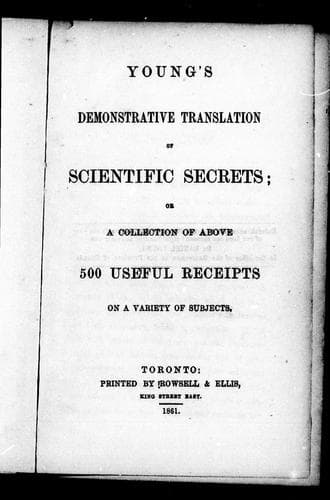
Young's Demonstrative Translation of Scientific Secrets: Or, A Collection of Above 500 Useful Receipts on a Variety of SubjectsYoung, Daniel
Science
Young's Demonstrative Translation of Scientific Secrets: Or, A Collection of Above 500 Useful Receipts on a Variety of Subjects
Young, Daniel
Formulas, recipes, etc.; Science -- Methodology
This is the latest method, and that now in use. To a solution of
sulphate of copper, add a solution of ferrocyanide of pottasium, so
long as a precipitate continues to be formed. This is allowed to
settle, and the clear liquor being decanted the vessel is filled
with water, and when the precipitate settles the liquor is again
decanted, and continue to repeat these washings until the sulphate
of potash is washed quite out; this is known by adding a little
chloride of barium to a small quantity of the washings, and when
there is no white precipitate formed by the test, the precipitate is
sufficiently washed. A solution of cyanide of potassium is now added
to this precipitate until it is dissolved, during which process the
solution becomes warm by the chemical re-action which takes place.
The solution is filtered, and allowed to repose all night. If
the solution of cyanide of potassium that is used is strong, the
greater portion of the ferrocyanide of potassium crystalises in the
solution, and may be collected and preserved for use again. If the
solution of cyanide of potassium used to dissolve the precipitate is
dilute, it will be necessary to condense the liquor by evaporation
to obtain the yellow prussiate in crystals. The remaining solution
is the coppering solution; should it not be convenient to separate
the yellow prussiate by crystallization, the presence of that salt
in the solution does not deteriorate it nor interfere with its power
of depositing copper.
19. PECULIARITIES IN WORKING CYANIDE OF COPPER SOLUTION
The true composition of the salts thus formed by copper and cyanide
of potassium has not yet been determined, but their relations to
the battery and electrolyzation are peculiar. The solution must
be worked at a heat not less than from 150 to 200 degrees Farenheit
(that is not quite as hot a boiling water, which is 212 degrees
Farenheit.) All other solutions we have tried follow the laws, that
if the electricity is so strong as to cause gas to be evolved at
the electrode, the metal will be deposited in a sandy or powdered
state, but the solution of cyanide of copper and potassium is an
exception to these laws, as there is no reguline deposit obtained
unless gas is freely evolved from the surface of the article upon
which the deposit is taking place. As this solution is used hot, a
considerable evaporation takes place, which requires that additions
be made to the solution from time to time. If water alone be used
for this purpose it will precipitate a great quantity of the
copper as a white powder, but this is prevented by dissolving a
little cyanide of potassium in the water at the rate of 4 ounces
to the gallon. The vessels used in factories for this solution are
generally of copper, which are heated over a flue or in a sand-bath,
the vessel itself serving as the positive electrode of the battery;
but any vessel will suit if a copper electrode is employed when the
vessel is not of copper.
Public-domain text, read in full here on John Shaqi.
Reviews
Reviews
No reviews yet
Be the first to share your thoughts on this work.
Join the Discussion
Join the discussion
Sign in to leave a comment or review.
Sign InorCreate an account