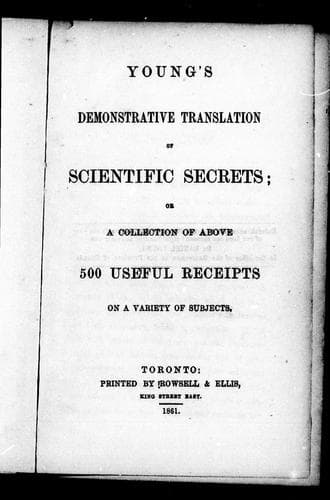
Young's Demonstrative Translation of Scientific Secrets: Or, A Collection of Above 500 Useful Receipts on a Variety of SubjectsYoung, Daniel
Science
Young's Demonstrative Translation of Scientific Secrets: Or, A Collection of Above 500 Useful Receipts on a Variety of Subjects
Young, Daniel
Formulas, recipes, etc.; Science -- Methodology
This is a beautiful, useful, and inexpensive art, easily acquired,
and producing imitation of the richest and rarest stained glass; and
also of making blinds, screens, skylights, Chinese lanterns, &c.,
in every variety of colour and design. In decorating his house, a
gentleman spends as much money as he can conveniently spare; the
elegancies and refinements of modern taste demand something more
than mere comfort; yet though his walls are hung with pictures, his
drawing-room filled with bijouterie, how is it that the windows of
his hall, his library, his staircase, are neglected? The reason is
obvious. The magnificent historical glass might be envied, but
could not be brought within the compass of ordinary means. Recent
improvements in printing in colours led the way to this beautiful
invention, by which economy is combined with the most perfect
results. A peculiar kind of paper is rendered perfectly transparent,
upon which designs are printed in glass colours, (vitro de
couleurs,) which will not change with the light. The paper is
applied to the glass with a clear white varnish, and when dry, a
preparation is finally applied, which increases the transparency,
and adds tenfold brilliancy to the effect. There is another design,
printed in imitation of the half-light (abatiour;) this is used
principally for a ground, covering the whole surface of the glass,
within which (the necessary spaces having been previously cut out
before it is stuck on the glass,) are placed medallion centres of
Watteau figures, perfectly transparent, which derive increased
brilliancy from the semi-transparency of the surrounding country.
To ascertain the quantity of designs required, measure your glass
carefully, and then calculate how many sheets it will take. The
sheets are arranged so that they can be joined together
continuously, or cut to any size or shape.
Public-domain text, read in full here on John Shaqi.
Reviews
Reviews
No reviews yet
Be the first to share your thoughts on this work.
Elsewhere in the archive
Join the Discussion
Join the discussion
Sign in to leave a comment or review.
Sign InorCreate an account