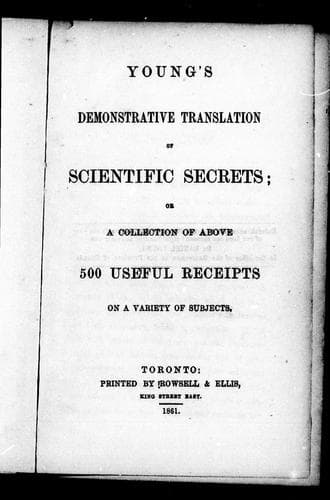
Young's Demonstrative Translation of Scientific Secrets: Or, A Collection of Above 500 Useful Receipts on a Variety of SubjectsYoung, Daniel
Science
Young's Demonstrative Translation of Scientific Secrets: Or, A Collection of Above 500 Useful Receipts on a Variety of Subjects
Young, Daniel
Formulas, recipes, etc.; Science -- Methodology
Practical Instructions.--Choose a fine day for the operation, as the
glass should be perfectly dry and unaffected by the humidity of the
atmosphere. Of course, if you have a choice, it is more convenient
to work on your glass before it is fixed in the frame. If you are
working on a piece of unattached glass, lay it on a flat table, (a
marble slab is preferable,) over which you must previously lay a
piece of baize of cloth to keep the glass steady. The glass being
thus fixed, clean and polish the side on which you intend to
operate, (in windows this is the inner side,) then with your brush
lay on it very equably a good coat of the prepared varnish; let
this dry for an hour, more or less, according to the dryness of the
atmosphere and the thickness of the coat of varnish. Meantime cut
and trim your designs carefully to fit the glass, (if it is one
entire transparent sheet you will find it little trouble;) then lay
them on a piece of paper, face downwards, and damp the back of them
with a sponge, applied several times, to equalise the moisture.
After this operation, arrange your time so that your designs may now
be finally left to dry for fifteen minutes before application to the
glass, the varnish on which has now become tacky or sticky, and in
a proper state to receive them. Apply the printed side next to the
glass without pressure; endeavour to let your sheet fall perfectly
level and smooth on your glass so that you may avoid leaving
creases, which would be fatal. Take now your palette, lay it flat on
the design, and press out all the air bubbles, commencing in the
centre, and working them out from the sides; an ivory stick will
be found useful in removing creases; you now leave this to dry,
and after twenty-four hours apply a slight coat of the liqueur
diaphane, leaving it another day, when if dry, apply a second coat
of the same kind, which must be left several days: finally, apply a
coat of varnish over all. If these directions are carefully followed,
your glass will never be affected by time or by any variations in
the weather: it will defy hail, rain, frost and dust, and can be
washed the same as any ordinary stained glass, to which, in some
respects, it is even superior. It is impossible to enumerate the
variety of articles to the manufacture of which diaphanie may be
successfully applied as it is not confined to glass, but can be done
on silk, parchment, paper, linen, &c., after they have been made
transparent, which may be accomplished in the following manner:--
stretch your paper, or whatever it may be, on a frame or drawing
board, then apply two successive coats (a day between each,) of
diaphanous liquor, and after leaving it to dry for several days,
cover it with a thin layer of very clear size, and when dry it will
be in a fit state to receive the coat of varnish and the designs.
Silk, linen, or other stuffs, should be more carefully stretched,
and receive a thicker coat of size than paper or parchment; the
Public-domain text, read in full here on John Shaqi.
Reviews
Reviews
No reviews yet
Be the first to share your thoughts on this work.
Elsewhere in the archive
Join the Discussion
Join the discussion
Sign in to leave a comment or review.
Sign InorCreate an account