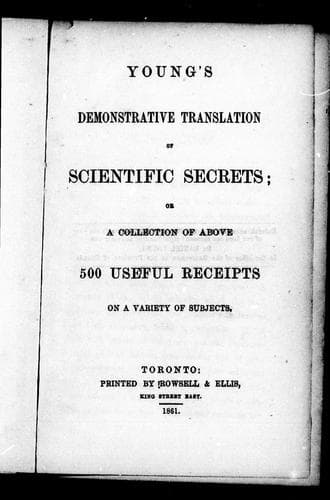
Young's Demonstrative Translation of Scientific Secrets: Or, A Collection of Above 500 Useful Receipts on a Variety of SubjectsYoung, Daniel
Science
Young's Demonstrative Translation of Scientific Secrets: Or, A Collection of Above 500 Useful Receipts on a Variety of Subjects
Young, Daniel
Formulas, recipes, etc.; Science -- Methodology
Directions.--We will suppose the object selected for imitation to be
a Chinese vase. After providing yourself with a plain glass vase, of
the proper shape, you take your sheets of coloured prints on which
are depicted subjects characteristic of that peculiar style. From
these sheets you can select a great variety of designs, of the most
varied character, on the arrangement and grouping of which you can
exercise your own taste. After you have fully decided upon the
arrangement of your drawings, cut them out accurately with a pair of
scissors, then apply some liquid gum carefully over the coloured
side of the drawings, and stick them on the inside of the vase,
according to your own previous arrangement--pressing them down till
they adhere closely, without any bubbles of air appearing between
the glass and the drawings. When the drawings have had sufficient
time to dry, take a fine brush and cover every part of them (without
touching the glass) with a coat of parchment size or liquid gum,
which prevents the oil colour (which is next applied) from sinking
into or becoming absorbed by the paper. When the interior of the
vase is perfectly dry, and any particles of gum size that may have
been left on the glass have been removed, your vase is ready for the
final and most important process. You have now to tint the whole
of the vase with a proper colour to give it the appearance of
porcelain; for up to this time, you will recollect, it is but a glass
vase, with a few coloured prints stuck thereon. Select from your
stock of prepared colours, in bottles, the tint most appropriate to
the kind of china you are imitating, (as we are now supposed to be
making a Chinese vase, it will be of a greenish hue,) mix fully
sufficient colour in a glass vessel, then pour the whole into the
vase. Take now your vase in both hands, and turn it round
continually in the same direction, until the colour is equally
spread over the whole of the interior: when this is satisfactorily
accomplished, pour back the remainder. If the prepared colour is too
thick, add a little varnish to the mixture before applying it. If
preferred, the colour may be laid on with a soft brush. Should the
vase be intended to hold water, the interior must be well varnished
after the above operations, or lined with zinc or tin foil. If the
potichomanist wishes to decorate the mouth of his vase with a gold
border, he can do so by mixing some gold powder in a few drops of
the essence of lavender and some varnish, applying it on the vase
with a fine brush; or he can purchase gold bands, already prepared
for application, in varied sheets, suitable to the potichomanie
designs. Potichomanists have found the art capable of greater
results than the mere imitation of porcelain vases, by the
introduction of glass panels (previously decorated with beautiful
flowers on a white ground) into drawing-room doors, and also into
walls which, being panel papered, offer opportunities of introducing
Public-domain text, read in full here on John Shaqi.
Reviews
Reviews
No reviews yet
Be the first to share your thoughts on this work.
Elsewhere in the archive
Join the Discussion
Join the discussion
Sign in to leave a comment or review.
Sign InorCreate an account