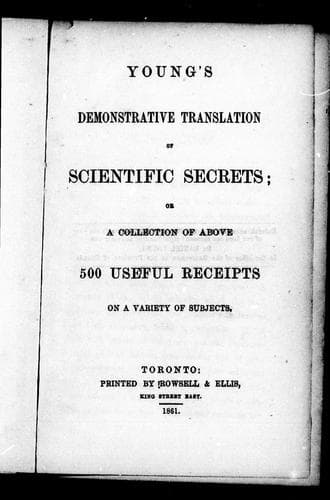
Young's Demonstrative Translation of Scientific Secrets: Or, A Collection of Above 500 Useful Receipts on a Variety of SubjectsYoung, Daniel
Science
Young's Demonstrative Translation of Scientific Secrets: Or, A Collection of Above 500 Useful Receipts on a Variety of Subjects
Young, Daniel
Formulas, recipes, etc.; Science -- Methodology
centre pieces of the same character as the doors; elegant chess
and work-tables, folding and cheval-screens, panels for cabinets,
chiffoniers and book-cases, slabs for pier and console-tables,
glove-boxes, covers for books, music, albums, &c. The most common
cause of failure is, that the drawings inside are not thoroughly
pressed down.
560. COLOURING FOR CHEESE
The colouring for cheese is, or at least should be, Spanish arnotto;
but as soon as colouring became general in this country, a colour of
an adulterated kind was exposed for sale in almost every shop; the
weight of a guinea and a half of real Spanish arnotto is sufficient
for a cheese of fifty pounds' weight. If a considerable part of the
cream of the night's milk be taken for butter, more colouring will
be requisite. The leaner the cheese is, the more colouring it
requires. The manner of using arnotto is to tie up, in a linen rag,
the quantity deemed sufficient, and put into half a pint of warm
water over night. This infusion is put into the tub of milk, in the
morning, with the rennet infusion; dipping the rag into the milk,
and rubbing it against the palm of the hand as long as any colour
runs out.
561. TO SHARPEN EDGE TOOLS
Take equal parts of flour of emery and crocus; make into a paste
with sweet oil; have now a piece of buck-skin, (hemlock tan,) tack
it by each end on a piece of board, with the grain uppermost; then
on this spread a little of the paste, and sharpen your tools on it.
You will, indeed, be astonished at the effect. Try it.
562. BLUE COMPOSITION FOR DYEING
Take equal parts of vitriol and indigo; powder them very finely,
separately, and mix.
563. TO GILD LETTERS ON VELLUM OR PAPER
Letters written on vellum or paper are gilded in three ways; in the
first, a little size is mixed with the ink, and the letters are
written as usual; when they are dry, a slight degree of stickiness
is produced by breathing on them, upon which the gold leaf is
immediately applied, and by a little pressure may be made to adhere
with sufficient firmness. In the second method, some white lead of
chalk is ground up with strong size, and the letters are made with
this by means of a brush; when the mixture is almost dry, the gold
leaf may be laid on, and afterwards burnished. The last method is to
mix up some gold powder with size, and make the letters of this by
means of a brush.
564. TO PRESERVE STRAWBERRY PLANTS
Sir Joseph Banks, from a variety of experiments, and the experience
of many years, recommends a general revival of the now almost
obsolete practice of laying straw under strawberry plants, when the
fruit begins to swell; by which means the roots are shaded from the
sun, the waste of moisture by evaporation prevented, the leaning
fruit kept from damage by resting on the ground, particularly in wet
weather, and much labour in watering saved. Twenty trusses of long
straw are sufficient for 1800 feet of plants.
565. MANAGEMENT OF STRAWBERRY PLANTS
Public-domain text, read in full here on John Shaqi.
Reviews
Reviews
No reviews yet
Be the first to share your thoughts on this work.
Elsewhere in the archive
Join the Discussion
Join the discussion
Sign in to leave a comment or review.
Sign InorCreate an account