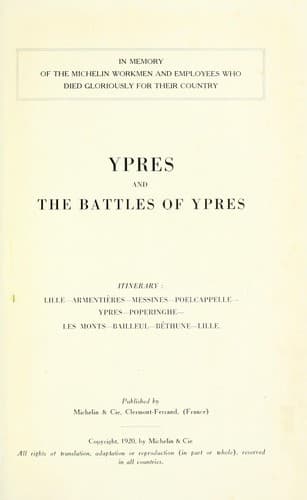
Belgium -- Guidebooks; France -- Guidebooks; World War, 1914-1918 -- Battlefields -- Guidebooks; World War, 1914-1918 -- Belgium -- Ieper
As early as the 12th, but especially in the 13th and 14th centuries,
Ypres, thanks to important privileges granted by the Counts of Flanders,
became a considerable town, and possessed 4,000 looms.
Flanders, the meeting-point of the three great European states--England,
France and Germany--was then the industrial centre _par excellence_ of
the west and the rendezvous of all the merchants of the old world. This
explains the splendour of the towns of Flanders in the Middle Ages, not
only Ypres, but Bruges, Ghent, etc.
This prosperity was often a temptation to the Kings of France, who led
many an expedition into Flanders. Ypres was taken by Louis VI. in 1128,
by Philippe-Auguste in 1213, by Philippe-le-Bel in 1297, but the town
was little damaged in these wars.
It suffered more in the 14th century. Riots, and the siege and
destruction of the town by the people of Ghent in 1383, caused many of
the weavers to emigrate, and left as its only industry the manufacture
of Valenciennes lace. At that time the Counts of Flanders were French
princes. Robert de Béthune was succeeded in 1322 by the Count of Nevers,
whose family reigned until 1384. This dynasty ended with Louis-le-Mâle,
and Philippe-le-Hardi, Duke of Burgundy, became Count of Flanders. Under
the rule of these Dukes, who were fairly wise and moderate
statesmen--Flanders being a source of considerable revenue, and the
Flemish people quick to revolt against any violation of their
privileges--Ypres prospered greatly.
[Illustration: YPRES IN THE 16TH CENTURY]
In 1481 Flanders passed under the rule of Austria (Marie, heiress of
Burgundy, had married the Archduke Maximilian), then in 1558 under that
of Spain. In 1559 it replaced Thérouanne as the centre of the diocese.
At that time it had lost much of its splendour. Towards the end of the
15th century it was depopulated by a dreadful pestilence, and about the
middle of the following century, a second outbreak completed the ruin of
the town. It was just beginning to recover when it was captured by the
_Gueux_ and the troops of the Duc d'Albe and Alexandre Farnèse, who
massacred most of the inhabitants.
In the 17th century Ypres was taken by the French on four
occasions--1648, 1649, 1658 and 1678--finally reverting to France under
the Treaty of Nimègue at about the latter date. Vauban fortified it.
Retaken by the Imperial Troops in 1715, Ypres was restored to France in
1792, and under the Empire became the capital of the Département of Lys.
The treaties of 1815 gave it back to the Netherlands, and since 1830 it
has formed part of the Kingdom of Belgium.
[Illustration: GERMAN BOMBARDMENT OF THE ASYLUM]
Public-domain text, read in full here on John Shaqi.
Reviews
Reviews
No reviews yet
Be the first to share your thoughts on this work.
Join the Discussion
Join the discussion
Sign in to leave a comment or review.
Sign InorCreate an account