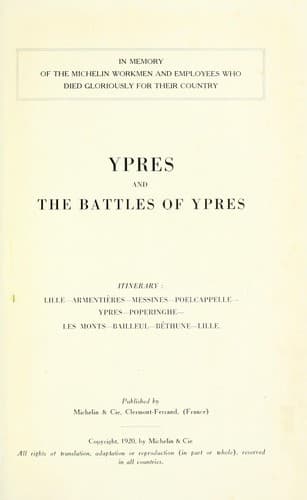
Belgium -- Guidebooks; France -- Guidebooks; World War, 1914-1918 -- Battlefields -- Guidebooks; World War, 1914-1918 -- Belgium -- Ieper
Towards the middle of September there was a rather severe bombardment
near Steenstraat and Ramscappelle, while Ypres received 300 more shells.
During the latter half of August an Order of the Day to the German
Armies in Flanders stated: "_Our work is practically finished in the
East, and we are on the point of beginning in the West; peace in October
is certain._"
[Illustration: THE FRONT LINE FROM JUNE 1915 TO JUNE 1917]
In December, a new offensive by the Germans failed, despite the use of
gas. There was unusual artillery activity, all the heavy guns, both
German and British, being brought into action.
On December 30, Field-Marshal French received the title of "Viscount of
Ypres," in commemoration of the vigorous British defence of that city.
On February 12, 1916, the Germans launched fresh attacks in the west,
near Steenstraat and Het Sas, and attempted to cross the Yser. After
being smartly checked, they furiously attacked the British trenches
between the Ypres-Comines Canal and the railway, and succeeded in
capturing one of them for a length of 600 yards. This trench, on
account of its frequently changing hands, came to be known as the
"International Trench." A few days later (March 2) the British retook
it.
The struggle now became limited to a continuous artillery duel, with
occasional surprise infantry attacks. The hamlet of St. Eloi to the
south was the scene of constant fighting for the possession of the
shell-craters.
On April 19, the fighting assumed a more serious character. An
unimportant German attack near St. Eloi and along the Ypres-Langemarck
Road was the prelude to operations by considerable enemy forces, having
for their objective the great undulating slopes between Hill 60 and
Armentières.
[Illustration: BRITISH DEFENCE WORKS IN FRONT OF YPRES]
The first of these attacks took place on April 25, 1916, but failed. Two
days later a night attack with gas was repulsed with hand grenades.
A third attempt was made in May, 1916, more to the south towards
Armentières, on the sides of the road connecting that town with Ypres.
The British, entrenched in a wood near Ploegsteert Village, were
assailed by three German columns, and were only able to repulse two of
them. The third took the position, but Scottish troops counter-attacked
and drove the Germans back.
The most important of the enemy attacks during this period took place on
June 1. The preparations included a concentration of troops between
Tournai and Baisieux, from May 21 to 27, supported by guns of all
calibres. The attack was carried out in considerable strength between
Hooge and the Ypres-Comines Railway.
Public-domain text, read in full here on John Shaqi.
Reviews
Reviews
No reviews yet
Be the first to share your thoughts on this work.
Join the Discussion
Join the discussion
Sign in to leave a comment or review.
Sign InorCreate an account