Produced by Al Haines
==============================================================
This work is licensed under a
Creative Commons Attribution 3.0 Unported License,
http://creativecommons.org/
==============================================================
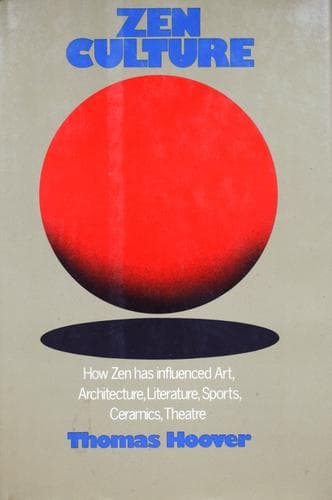
ZEN CULTURE
Anyone who examines the Zen arts is immediately struck by how modern
they seem. The ceramics of 16th-century Zen artists could be
interchanged with the rugged pots of our own contemporary crafts
movement; ancient calligraphies suggest the monochromes of Franz Kline
or Willem de Kooning; the apparent nonsense and illogic of Zen parables
(and No theater and Haiku poetry) established the limitations of
language long before the theater of the absurd; 400-year-old Zen
architecture seems to be a copy of modern design ideas such as modular
sizing, exposed woods, raw materials, bare walls, uncluttered space and
a California marriage of house and garden.
Zen values experiencing things over analyzing them. Perhaps if we can
take the power of direct perception, sharpened by the devices of Zen
art, back to everyday activities, we will find a beauty in common
objects that we previously ignored.
Selected Reviews
_The notoriously grumpy _Kirkus Reviews _said, "Thomas Hoover has a
considerable gift for expressing his appreciation and understanding of
various arts associated with Zen. . . . These are deftly treated, with
a concise synopsis of the historical development of each; and together
Hoover's discussions provide an excellent introduction to the
aesthetics of Japanese culture."
_Library Journal _said, "Hoover covers the ground in an easy and
informative way, describing the origins of Zen itself and the Zen roots
of swordsmanship, architecture, food, poetry, drama, ceramics, and many
other areas of Japanese life. The book is packed with facts, the
bibliography is excellent, the illustrations few but most appropriate,
and the style clear and smooth. A most useful book for all
collections."
_Asian Studies _declared, "Highly recommended. ZEN CULTURE moves easily
from the political climate that gave rise to Zen to the cultural areas
- art, architecture, theatre, literature, flower arrangement, design,
archery, swordsmanship - where Zen has manifested itself."
As for the influence of the Zen aesthetic, the_ Houston Chronicle
_said, "Hoover suggests we need only look around. Modern furniture is
clean, simple lines in unstained, unadorned woods. And that old fad
became a habit, houseplants. These are all expressions of ideas born
with Zen: understatement, asymmetry, intuitive perception, nature
worship, disciplined reserve."
"Highly recommended," said _The Center for Teachers of Asian Studies._
Public-domain text, read in full here on John Shaqi.
Reviews
Reviews
No reviews yet
Be the first to share your thoughts on this work.
Join the Discussion
Join the discussion
Sign in to leave a comment or review.
Sign InorCreate an account