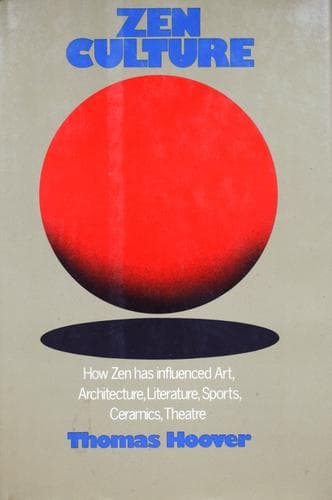
The third face of Zen, the deep concern with and understanding of what
constitutes beauty, also preceded Zen culture in Japan to some degree.
As with many of the existing Japanese art forms, the native sense of
taste was co-opted by Zen culture and bent to the rules of Zen.
Aesthetic discernment was as important for social advancement in
medieval, pre-Zen Japan as good grammar is in the West today, and the
characteristic attention to small details, the genuine ability to
notice things, from the feathered pastel hues of a partially opened
blossom to the colored refractions in a drop of dew, was already well
developed. In the centuries before Zen, the notion that aesthetics in
Japan could reflect a philosophical point of view would have seemed
strange. But to the taste-makers of Zen culture the arts were the
handmaiden of spiritual ideas; their arts had to make a statement, and
as a result art became an expression of religion, not so much a direct,
point-blank depiction of religious motifs as in Christian art, but
rather a belief that art itself is an inherently religious concern--an
idea Zen shares with the ancient Greeks. But whereas the Greeks strove
for perfect form as an exemplification of man's kinship with the gods,
the Zen artist carefully avoids final perfection, not wishing to
idealize a physical world whose very existence he finds problematical.
Perhaps the most noticeable principle of Zen art is its asymmetry; we
search in vain for straight lines, even numbers, round circles.
Furthermore, nothing ever seems to be centered. Our first impulse is to
go into the work and straighten things up--which is precisely the effect
the artist intended. Symmetrical art is a closed form, perfect in
itself and frozen in completeness; asymmetrical art invites the
observer in, to expand his imagination and to become part of the
process of creation. The absence of bilateral symmetry mysteriously
compels the observer to reach past surface form and touch the
individuality of a work. Even more important, Zen asymmetry forcefully
draws one away from any mental connection one might have between
completed form and notions of completion and timelessness in material
things. Zen denies the significance of the external world and
underscores the point by never depicting it in static, stable, or
closed terms. Greek art was a tribute to perfection; Zen art is a
statement, if only implicit, that the objective world should never be
taken too seriously.
The ideas taught by asymmetry in the visual arts are paralleled in the
literary arts by the device of suggestion. This quality, first seen in
pre-Zen aristocratic poetry, was brought to new heights by the Zen
Haiku poets. Among other things, a Haiku poem sets you up for the last
line, which kicks your imagination spinning into imagery. The most
famous Haiku poem of all probably demonstrates this quality as well as
any:
_An ancient pond;
A frog leaps in:
The sound of water.
Public-domain text, read in full here on John Shaqi.
Reviews
Reviews
No reviews yet
Be the first to share your thoughts on this work.
Join the Discussion
Join the discussion
Sign in to leave a comment or review.
Sign InorCreate an account