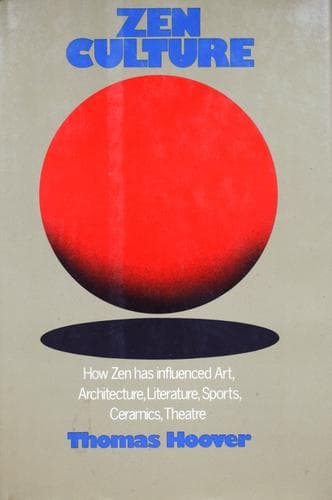
If we in the West wish to borrow from the complex world of Zen culture,
we must first begin to train and intensify our powers of perception. In
this regard, one is tempted to speculate that the Japanese must have
learned to turn these powers down as well as up. How else can one
explain the Japanese ability to ignore so much of the blight of modern
civilization while maintaining a national fetish for such purely
aesthetic phenomena as cherry blossoms? As Donald Richie observed,
"Japan is the most modern of all countries perhaps because, having a
full and secure past, it can afford to live in the instantaneous
present."0 Alongside all the aesthetic indignities of the twentieth
century, the ancient sense of taste appears to have survived
undiminished. A concern for beauty is still very much a part of
everyday life in Japan. Whereas the appreciation of art is usually the
pursuit of a privileged few in Western countries, in Japan the
aesthetic quality of everyday objects is commonly acknowledged to be
fully as important as their function. It is not uncommon to discover a
rustic day laborer arranging flowers, practicing the tea ceremony, or
fashioning a garden in his spare time. The peasant may be as sure a
judge of tea bowls as the prince. Even the match boxes from the
sleaziest bars are minor works of art, as are bundles and packages from
even the most modern commercial establishments. A sense of beauty is
not considered unmanly; indeed, it is regarded as essential to the good
life, harking all the way back to the virile _samurai_.
Zen culture's primary lesson is that we should start trying to
experience art and the world around us rather than analyzing
them. When we do this, we find that everything suddenly comes alive. If
we can take this power of direct perception, sharpened by the devices
of Zen art, back to everyday activities, we will find a beauty in
common objects that we previously ignored. Flowers--indeed individual
petals--become objects of the most intense loveliness. When we see the
world with a Zen-honed awareness, our sense of the beauty in objects
supplants our desire to possess them. If we allow the ancient creators
of Zen culture to touch our lives, we open wider the doors of
perception.
* * *
References
CHAPTER 2 THE PRELUDE TO ZEN CULTURE
1. "The Diary of Murasaki Shikibu," from Diaries of Court Ladies of Old
Japan, trans. Omori, Annie Shepley, and Kochi Doi (Tokyo, 1935; reprint
ed., New York, AMS Press), p. 147.
2. The Pillow Book of Sei Shonagon, trans. Ivan Morris (New York:
Columbia University Press, 1967), p. 40.
3. Ibid., p. 214.
4. "The Diary of Murasaki Shikibu," p. 74.
5. The Kokin Waka-shu, trans. H. H. Honda (Tokyo: Hoku-seido Press,
1970), p. 35.
6. See Wm. Theodore de Bary, ed., Sources of Japanese Tradition, vol. 1
(New York: Columbia University Press, 1958).
Public-domain text, read in full here on John Shaqi.
Reviews
Reviews
No reviews yet
Be the first to share your thoughts on this work.
Elsewhere in the archive
Join the Discussion
Join the discussion
Sign in to leave a comment or review.
Sign InorCreate an account