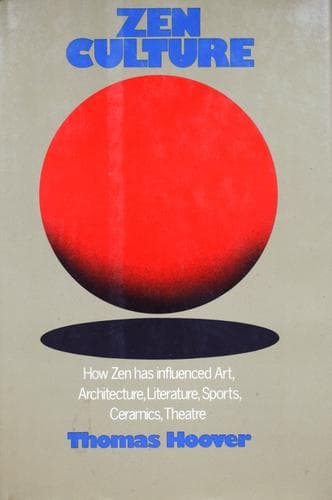
ZEN CULTURE did not spring upon the Japanese islands as an alien force,
dislodging native beliefs, ideals, and values. It could indeed be
argued that precisely the opposite happened, that the Japanese actually
used Zen as a framework over which to organize their own eclectic
beliefs about reverence toward nature, aesthetics, anti-
intellectualism, artistic forms and ideals, and basic attitudes toward
life. The truth, however, lies somewhere between: Zen did not reshape
Japan, but neither did Japan reshape Zen. Rather, the two melted
together, with the resulting amalgam often seeming to be all Zen, while
actually being, in many instances, merely older Japanese beliefs and
ideals in a new guise.
Some of the most fundamental qualities of Japanese civilization had
their origins in high antiquity, when the Japanese had no writing and
worshiped gods found among fields and groves. These early Japanese had
no religious doctrines other than respect for the natural world and the
sanctity of family and community. There were no commandments to be
followed, no concept of evil. Such moral teachings as existed were that
nature contains nothing that can be considered wicked, and therefore
man, too, since he is a child of nature, is exempt from this flaw. The
only shameful act is uncleanliness, an inconsiderate breach of the
compact between man and nature.
The early Japanese left no evidence that they brooded about nature or
required rituals to subdue it. Rather, the natural world was welcomed
as a joyous if unpredictable companion to life, whose beauty alone was
sufficient to inspire love. This reverence for nature, which lay deep
within the Japanese psyche, was in later centuries to become a
fundamental part of Zen culture. Like the early Japanese, the followers
of Zen believed the world around them was the only manifestation of god
and did not bother with sacred icons or idols, preferring to draw
religious symbolism directly from the world as it stood.
The first arrivals on the Japanese archipelago were a Stone Age people,
known today as "Jomon," who left artifacts across a time span beginning
in the fourth millennium B.C. and lasting until the early Christian Era.
Arriving in Japan from northeast Asia via a land bridge now submerged,
they remained primarily in the north, where they lived in covered pits,
buried their dead in simple mounds, and, most importantly for the later
Japanese, developed a ceramic art of low-fired vessels and figurines
whose loving awareness of material and form re-emerged centuries later
as a characteristic of Zen art.
Public-domain text, read in full here on John Shaqi.
Reviews
Reviews
No reviews yet
Be the first to share your thoughts on this work.
Join the Discussion
Join the discussion
Sign in to leave a comment or review.
Sign InorCreate an account