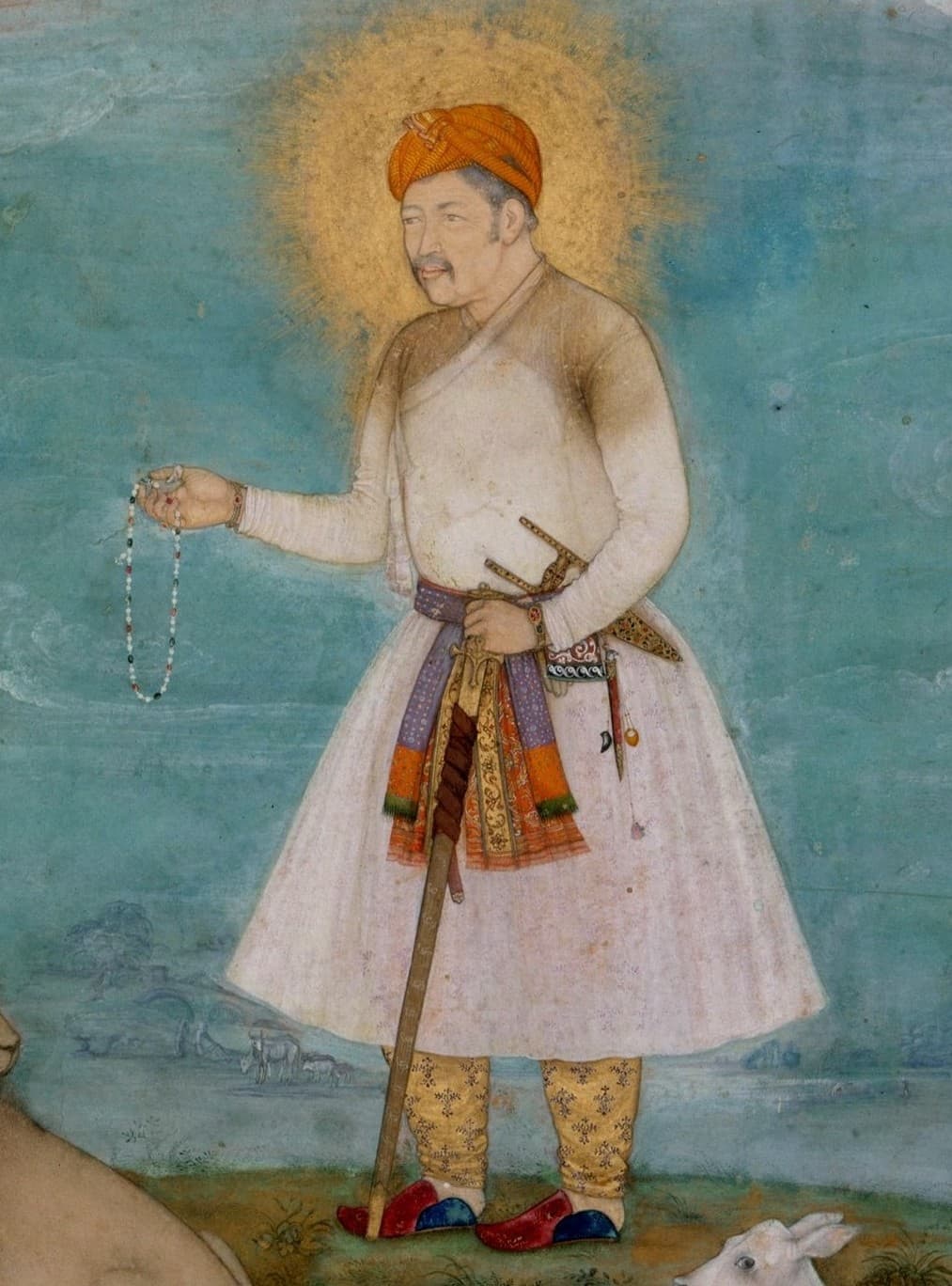
Life
Jalal al-Din Muhammad Akbar, third Mughal emperor, was born in 1542 at Umarkot in Sind, in the refugee camp of his father Humayun's exile, and inherited the throne at thirteen in 1556 with the dynasty holding little more than a toehold at Delhi. The regency of Bayram Khan and the second battle of Panipat (1556) against Hemu saved it; the emperor's own half-century then built it into the great Mughal state: Malwa, Gondwana, the Rajput kingdoms by war and marriage alliance, Gujarat 1573, Bengal 1576, Kashmir 1586, Sind 1591, Kandahar 1595, the Deccan's edge at his death in 1605. He died at Agra and lies in the tomb at Sikandra his son completed.
His court is documented as few in Islamic history are: the Akbarnama and A'in-i Akbari of his minister and ideologue Abu'l-Fazl — panegyric but encyclopedic — and, against them, the private chronicle of Badauni, the orthodox critic at his own court, whose Muntakhab al-Tawarikh records what the official history would not. Between those two mirrors stands the emperor the traditions still argue over: illiterate by every account yet master of a library of readers, patron of translation (the Mahabharata into Persian as the Razmnama), builder of Fatehpur Sikri, and author of the imperial settlement — sulh-i kull, "peace with all" — that defined Mughal rule at its height.
The Struggle
Akbar's first struggles were for mastery of his own house: the dismissal of Bayram Khan in 1560, the crushing of the Uzbek nobles' revolts and his foster-kin's ambitions in the 1560s, the rebellion raised in his brother Hakim's name from Kabul in 1581 — each documented in the chronicles with the emperor's characteristic speed of march. The military struggles the tradition remembers hardest are Rajput: Chittor 1568, where after the garrison's jauhar the sack and the killing of the peasant defenders — recorded in his own fathnama — remain the reign's darkest documented day; Ranthambore's honorable capitulation the next year showed the other face, and the Rajput alliance that followed became the empire's backbone.
His inner struggle is itself in the sources: the crisis of 1578 — the emperor's trance on the hunting field, the mass release of the game — and the years of the ibadat-khana debates at Fatehpur Sikri, where ulama, Brahmins, Jains, Parsis, and the Jesuit fathers of Goa disputed before a ruler asking, by Badauni's hostile and Abu'l-Fazl's reverent testimony alike, questions his establishment thought settled.
Teachings & Morals
The A'in-i Akbari preserves the machinery of his statecraft: the mansab ranking system that ordered the nobility, Todar Mal's revenue settlement measuring and assessing the land itself, and the abolitions the reign is cited for — the pilgrim tax in 1563, the jizya on non-Muslims in 1564, both recorded with dates in the chronicles. Sulh-i kull, universal conciliation, became the empire's stated principle: office open to Rajput and Iranian, Shia and Sunni, Hindu and Muslim by service rather than creed — a documented practice, whatever its theory owed to Sufi metaphysics or imperial convenience.
The religious experiments are the debated core. The 1579 mahzar — the declaration, signed under pressure by leading ulama, granting the just sultan authority to choose among jurists' opinions — and the discipleship order the sources call Din-i Ilahi (Abu'l-Fazl's "tawhid-i ilahi"), with its tiny initiate circle, sun veneration ceremonies, and imperial prostration, drew Badauni's charge of apostasy from Islam and later historians' counter-reading of a Sufi-inflected kingship cult that never claimed prophecy nor abrogated the sharia for the realm. Both readings rest on the same documents; the entry carries them as the traditions and the historians do.
Wars & Conflicts
Panipat 1556 saved the dynasty; the sieges of Chittor and Ranthambore (1568–69) broke Rajput resistance and built the alliance; Gujarat 1573 — with the legendary eleven-day camel dash to relieve Ahmedabad — gave the empire the sea; the Bengal campaigns (1574–76) and the long pacification against Afghan resistance gave it the east's revenues. Haldighati 1576 against Rana Pratap of Mewar opened the generation-long guerrilla that the empire never fully closed — the Rajput epic tradition and the Mughal chronicles preserve the same battles with opposite heroes, a documented double memory this platform reports as such.
The 1580s turned the emperor northwest — Kabul secured against his brother, Kashmir annexed 1586, the Yusufzai disaster in the Khyber avenged, Sind and Baluchistan absorbed, Kandahar recovered — and the 1590s south: Ahmadnagar besieged against Chand Bibi's documented defense, Asirgarh taken by gold as much as guns in 1601, while his son Salim's rebellion clouded the last years. The empire he left ran from Kabul to the Godavari on the chronicles' own maps.
The Debates
Historical figures are debated. What follows records the major questions raised by historians and within the traditions themselves — presented for study, not verdict.
Akbar is the most argued-over ruler in South Asian history, and the argument began at his own court. Badauni's chronicle indicts the mahzar, the discipleship order, the sun rites, the curbs he alleges on orthodox practice; Abu'l-Fazl's presents the same emperor as the age's spiritual axis; the Naqshbandi reaction after him — Sirhindi's letters — treated the reign as Islam's near-eclipse in India, while the Chishti connection (the Ajmer pilgrimages on foot, the Salim Chishti shrine at Sikri) roots him in Sufi devotion by the same record. Modern receptions replay the poles: secular India's founding precedent of pluralism; orthodox and Islamist memory's cautionary tale; Rajput and Hindu-nationalist memory divided between the ally of Man Singh and the sacker of Chittor.
The documented facts beneath the argument — the abolished taxes, the temple grants in the imperial farmans, the Chittor fathnama's own language, the mahzar's text, the tiny membership of the discipleship order, the unbroken mosque establishment of the realm — allow every party its case; the entry states the facts and the positions, and no verdict.
Legacy
The Mughal empire as history knows it — the administrative grid, the composite ruling class, the Indo-Persian court culture, the architectural synthesis running from Fatehpur Sikri to the Taj of his grandson — is Akbar's construction; his revenue and rank systems outlived the dynasty into the East India Company's manuals. The Persian Mahabharata, the workshop that married Persian miniature to Indian hand (figural court art, noted here as record, not reproduced), and the translation bureau made his court the great engine of Indo-Islamic cultural fusion.
His name remains South Asia's shorthand for the pluralist option in Muslim kingship — invoked by Nehru's India and contested in every generation's polemics since Sirhindi. That he is claimed and disclaimed with equal heat across four centuries is itself his measure: the emperor who made "peace with all" the stated principle of an Islamic empire, and left the traditions arguing — on his own courtiers' documents — what it had cost and what it had bought.