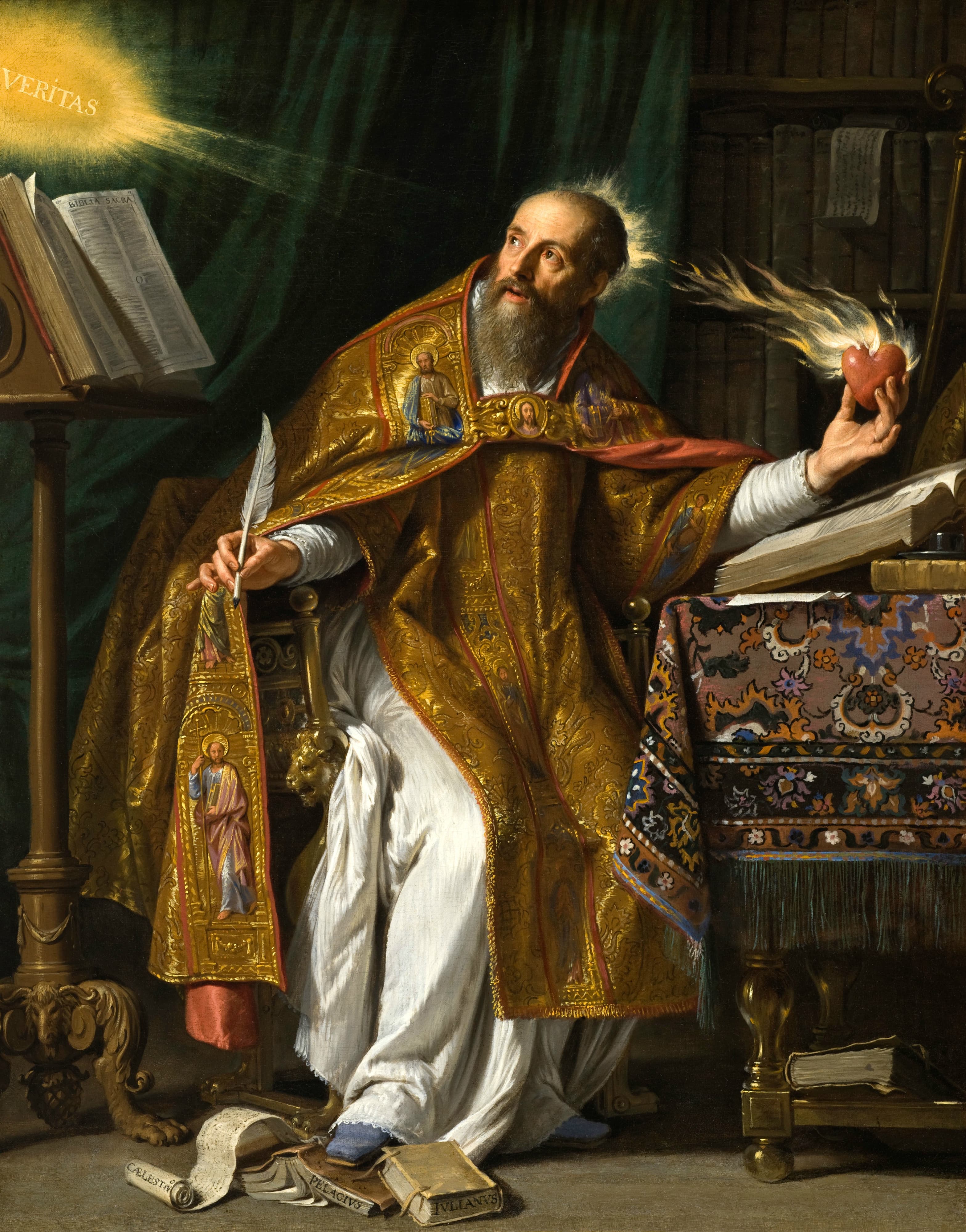
Life
Born in 354 at Thagaste in Roman North Africa to a pagan father and the Christian Monica, Augustine was a brilliant, worldly teacher of rhetoric who passed through Manichaeism and Neoplatonism before his conversion to Christianity at Milan in 386, recounted in his Confessions. Ordained and made bishop of Hippo, he spent the rest of his life preaching, writing, and contending with heresies and schisms, dying in 430 as the Vandals besieged his city.
The Struggle
The Confessions make his inner struggle famous: years of intellectual searching and moral conflict — his prayer "grant me chastity, but not yet" — before a wrenching conversion. As bishop he was embattled without: against the Manichees he had left, the Donatist schismatics who divided African Christianity, and the followers of Pelagius over the nature of grace and free will. He died with his world collapsing, Rome sacked in 410 and the barbarians at the gates of his own see.
Teachings & Morals
Augustine's thought centers on grace: that human beings, wounded by original sin, cannot turn to God by their own power but only through unmerited divine grace — a doctrine that shaped Western views of sin, will, and salvation for a millennium and a half. His City of God set the earthly and heavenly cities against each other and offered a Christian philosophy of history. His fusion of Christian faith with Neoplatonic philosophy, and his explorations of memory, time, and the will, made him a founder of Western introspection.
Wars & Conflicts
Augustine's battles were theological and ecclesiastical, not military — against Manichees, Donatists, and Pelagians — though he wrote influentially on the morality of war, helping shape the Christian "just war" tradition. He lived through the violence of a collapsing empire: the sack of Rome in 410, which prompted the City of God, and the Vandal invasion of Africa, whose siege of Hippo coincided with his death. His response to catastrophe was to write rather than to fight.
The Debates
Historical figures are debated. What follows records the major questions raised by historians and within the traditions themselves — presented for study, not verdict.
Augustine's legacy is as contested as it is vast. His doctrine of predestination and grace, developed against Pelagius, has divided Christians ever since — Catholics, Calvinists, and Arminians all claim or resist him. His arguments justifying the coercion of the Donatist schismatics have been criticized as a charter for later religious persecution. His views on sexuality, original sin, and the place of women have drawn sharp modern critique. The debates are old, and each age has read its own Augustine; the sources are his own voluminous works.
Legacy
Augustine is the most influential theologian of Western Christianity, a Doctor of the Church whose ideas structured medieval thought and were reborn in the Reformation, when Luther (an Augustinian friar) and Calvin drew on his doctrine of grace. The Confessions is often called the first autobiography; the City of God shaped Western political theology. His reach extends into philosophy, from Descartes to the modern study of time and the inner life.