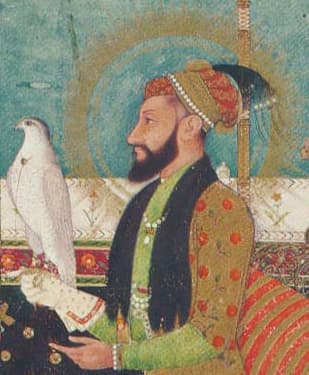
Life
Muhyi al-Din Muhammad Aurangzeb, sixth Mughal emperor, throne-name Alamgir — "world-seizer" — was born in 1618, third son of Shah Jahan, and won the empire in the war of succession of 1657–59: Dharmat and Samugarh against his brother Dara Shikoh, the imprisonment of his father in Agra fort until his death, and the executions of Dara (1659, on a charge of apostasy the chronicles record with its politics visible), Murad, and Dara's son. He reigned forty-nine years — the empire's territorial zenith — and died on campaign in the Deccan in 1707, at eighty-eight, leaving by his own testament instructions for a pauper's burial: his open-air grave at Khuldabad, paid for — the tradition records — by his own earnings from copying Qurans and sewing caps, stands in deliberate contrast to the Taj Mahal of his father.
The reign divides in the chronicles at 1681: the northern decades of consolidation — the Yusufzai and Jat and Satnami revolts, the annexation of the Rajput regency crisis of 1679–81, his son Akbar's rebellion — and then the quarter-century Deccan war: Bijapur taken 1686, Golconda 1687, the Maratha king Sambhaji executed 1689, and yet the Maratha resistance unbroken, fortress by fortress, until the emperor's death in the field. His own letters — the Ruq'at-i Alamgiri — and the official Maasir-i Alamgiri are the reign's nearest records, with the Italian Manucci and the fatwa compilation he commissioned rounding the documentation.
The Struggle
Aurangzeb's first struggle was fratricidal and constitutive: against Dara Shikoh — the eldest brother, Sufi-philosopher translator of the Upanishads — in a war the sources themselves cast as two versions of Mughal kingship; the execution on the ulama's apostasy verdict, with its evident political convenience, is documented from both sides' partisans. His second was with the Mughal compact itself: the Rajput crisis of 1679 (the disputed Marwar succession, Mewar's war, his son Akbar's defection to the Rajputs and flight to Persia) strained the alliance Akbar the Great had built, without — the records show — ever dissolving it: Rajput and Hindu mansabdars remained, by the registers, a larger share of his nobility than under any predecessor.
The Deccan was the struggle that consumed him: twenty-six years in tents, the treasury drained, the great nobles dying of age around him, Maratha bands answering every siege with raids deeper into imperial provinces. His last letters — despairing of his sons, reckoning his failures before God — are among the most personal documents any Muslim sovereign left: "I came alone and I go as a stranger... I have not done well for the country or its people."
Teachings & Morals
Aurangzeb's personal religion is uncontested in the record: memorizer of the Quran, keeper of fasts and vigils, copyist of scripture, austere in dress and treasury draw — the emperor as faqir, the image his grave completes. His great juristic monument is the Fatawa-i Alamgiri: the imperial commission of India's leading Hanafi scholars that produced the most authoritative law compendium of the later Islamic world, studied from Cairo to the colonial courts that renamed it.
His public religious policy is the argued record: the reimposition of the jizya in 1679 (with its documented exemptions and its documented protests), the general order of 1669 against certain temples and the specific documented demolitions — Kashi Vishwanath at Banaras, Keshava Deva at Mathura — alongside the equally documented farmans of protection and grant to other temples and maths (the Jangam Bari and Umanand grants among those preserved); the census of his nobility showing Hindus' share rising; the court music he renounced and the musicians the sources nonetheless record pensioned. The scholarship — from Jadunath Sarkar's classic indictment to modern reassessments — divides over whether policy was piety, punishment of rebellion, or both by turns; the primary documents carry all three faces, and the entry presents them without verdict.
Wars & Conflicts
The succession war of 1657–59 — Dharmat, Samugarh, Deorai — was the century's masterclass in Mughal civil war, won by generalship and defection alike. The reign's first half fought the empire's edges: the Yusufzai rising (1667), the Jat rebellions around Mathura, the Satnami revolt of 1672 crushed with the chronicles noting its strange ferocity, the Sikh Guru Tegh Bahadur's execution in 1675 — a wound Sikh memory holds central, documented in Persian and Sikh sources with their different framings — and the Rajput war of 1679–81 that sent his son into rebellion.
From 1681 the Deccan: the Adil Shahi and Qutb Shahi sultanates extinguished at Bijapur (1686) and Golconda (1687) — the latter after a betrayed gate and a defiance, Abdul Razzaq Lari's, the emperor himself pensioned for its loyalty; Sambhaji captured and executed in 1689; Jinji besieged eight years; and then the fortress war against Tarabai's Marathas that the Maasir records year by grinding year. At his death the empire stretched from Kabul to Tanjore on the map and was insolvent in the field — the paradox every historian of the reign begins from.
The Debates
Historical figures are debated. What follows records the major questions raised by historians and within the traditions themselves — presented for study, not verdict.
Aurangzeb is modern South Asia's most contested Muslim figure, and the contest is documentary before it is political. The indictment's exhibits: Dara's and Sambhaji's executions, Tegh Bahadur's martyrdom, the 1669 order and the Banaras and Mathura demolitions, the 1679 jizya, the music ban, the Shia sultanates' destruction with the sectarian rhetoric of their conquest. The defense's exhibits: the temple-protection farmans and grants, the rising Hindu share of his high nobility, the jizya's exemptions and fiscal context, the rebellion-punishment reading of the demolitions, the Fatawa's procedural legalism against arbitrary power, and the personal austerity no source denies. Sarkar's five volumes built the classic case for bigotry-driven decline; later scholarship (Athar Ali's registers, recent reassessments) rebuilt the political-context case; Pakistani, Indian, Hindu-nationalist, and Islamist public memories each keep their own Aurangzeb.
This platform's law applies squarely: the documents on both tables are named above; the traditions' and historians' positions are stated; no verdict is entered. What is not disputed: the Deccan's cost, the testament's grief, and the empire's fracture within a generation of his grave.
Legacy
Aurangzeb left the largest Mughal empire and the seeds of its dissolution: within a decade of Khuldabad the provinces were slipping to governors and Marathas, and the eighteenth century's successor states all date their rise from his death. The Fatawa-i Alamgiri remained the subcontinent's legal spine into the colonial period — his most durable act of state. The austere grave, the Quran-copying emperor, entered Muslim devotional memory as the model of the sovereign-ascetic; Iqbal honored him in that key.
In the region's modern politics he is a proxy war: renamed roads in Delhi, textbook battles in three countries, the standing antithesis (fair or not to both) of his great-grandfather Akbar in every debate about Islam and rule in South Asia. The historian's Aurangzeb — the letters, the registers, the farmans of grant and demolition side by side — remains stubbornly more complicated than any of the flags he is made to fly; this entry keeps him with his documents.