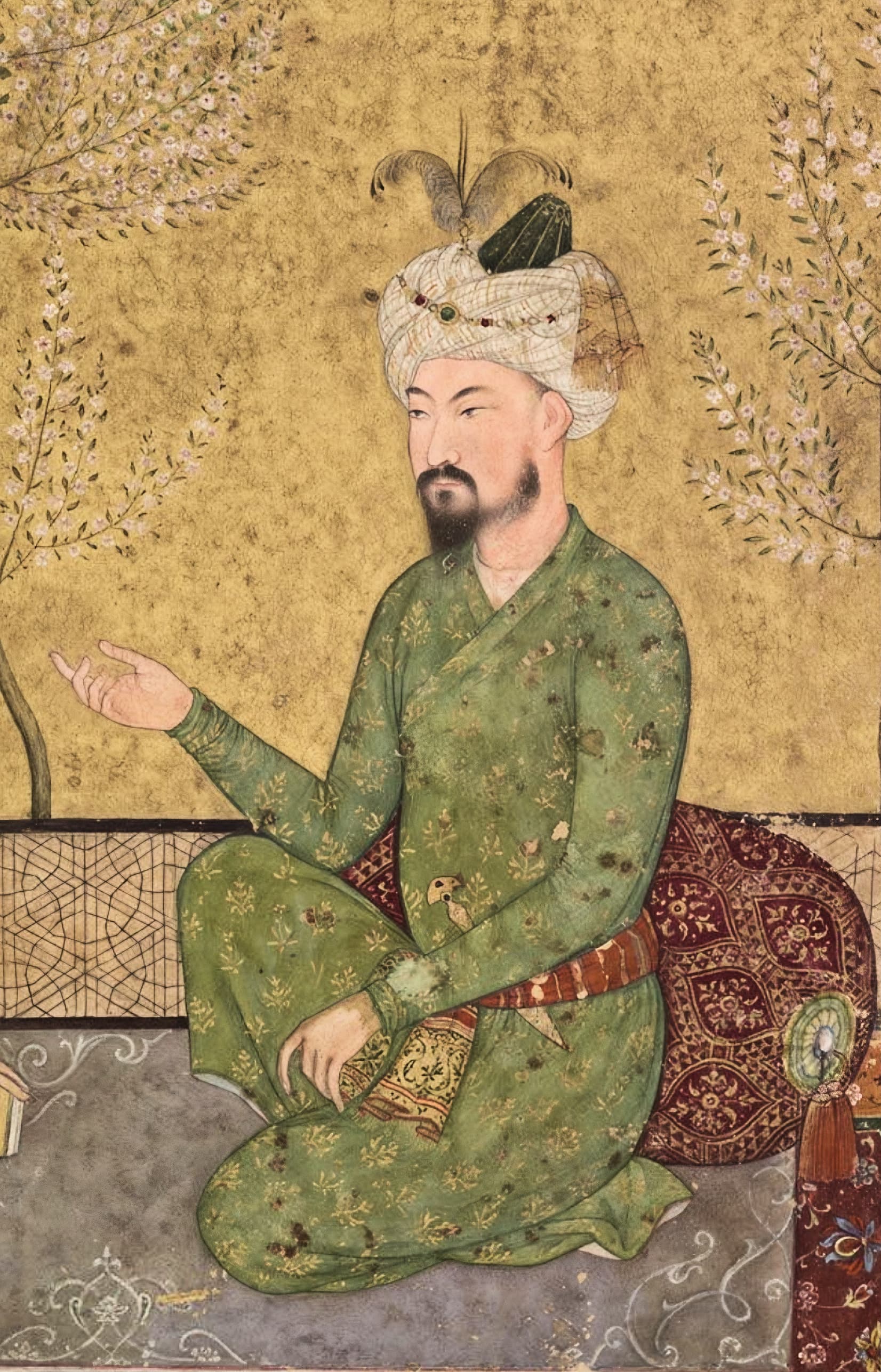
Life
Descended from Timur and Genghis Khan, Babur inherited the small kingdom of Fergana as a boy, lost and regained thrones in Central Asia, and finally turned south, taking Kabul and then invading India, where his victory at Panipat in 1526 founded the Mughal Empire. He died in 1530.
The Struggle
His early life was a struggle of exile and reversal — repeatedly winning and losing Samarkand and his homeland — before he built a new base at Kabul and gambled everything on the conquest of Hindustan against far larger armies.
Teachings & Morals
Babur is remembered as much for his pen as his sword: the Baburnama, his autobiography, is a candid, observant classic of world literature, recording his campaigns, his gardens, his failures, and the natural world with rare honesty.
Wars & Conflicts
He won the First Battle of Panipat (1526) against the Delhi Sultanate using field artillery and tactics, then defeated the Rajput confederacy under Rana Sanga at Khanwa (1527), securing the Mughal foothold in northern India.
The Debates
Historical figures are debated. What follows records the major questions raised by historians and within the traditions themselves — presented for study, not verdict.
His conquests brought destruction as well as empire, and the later dispute over the Babri Mosque, associated with his general, made his name a flashpoint in modern Indian politics — a controversy of memory largely later than the man. His memoir is prized for candor even about his own faults.
Legacy
Babur founded the Mughal Empire, which would rule much of the subcontinent for over three centuries and produce one of history's great cultural syntheses; his Baburnama remains a literary and historical treasure.