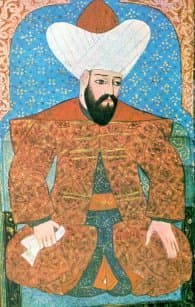
Life
Orhan succeeded Osman around 1323 and ruled nearly four decades, capturing Bursa as his capital, absorbing neighboring beyliks, and establishing a foothold in Europe at Gallipoli. He organized coinage, administration, and the beginnings of a standing army. He died in 1362, his realm now a rising power.
The Struggle
He worked to transform a raiding frontier emirate into an ordered state, competing with rival Turkish beyliks and exploiting Byzantine civil wars, into which he was drawn as ally and son-in-law of a Byzantine claimant.
Teachings & Morals
Orhan is credited with early state-building — minting coins, organizing the army, founding mosques and a medrese — that turned the Ottoman enterprise from a war-band toward an institutional polity.
Wars & Conflicts
He captured Bursa (1326) and Nicaea, defeated Byzantine forces at Pelekanon (1329), and seized Gallipoli (1354), establishing the first permanent Ottoman presence in Europe and opening the Balkans to later conquest.
The Debates
Historical figures are debated. What follows records the major questions raised by historians and within the traditions themselves — presented for study, not verdict.
The reliability of the sources for his reign is limited and partly later tradition, and the exact steps of Ottoman institutional growth under him are debated by historians. As a frontier ruler he is assessed directly.
Legacy
Orhan set the Ottoman state on the path from beylik to empire, gaining its first European territory and its early institutions; his long reign consolidated the gains of Osman and prepared the conquests of his successors.