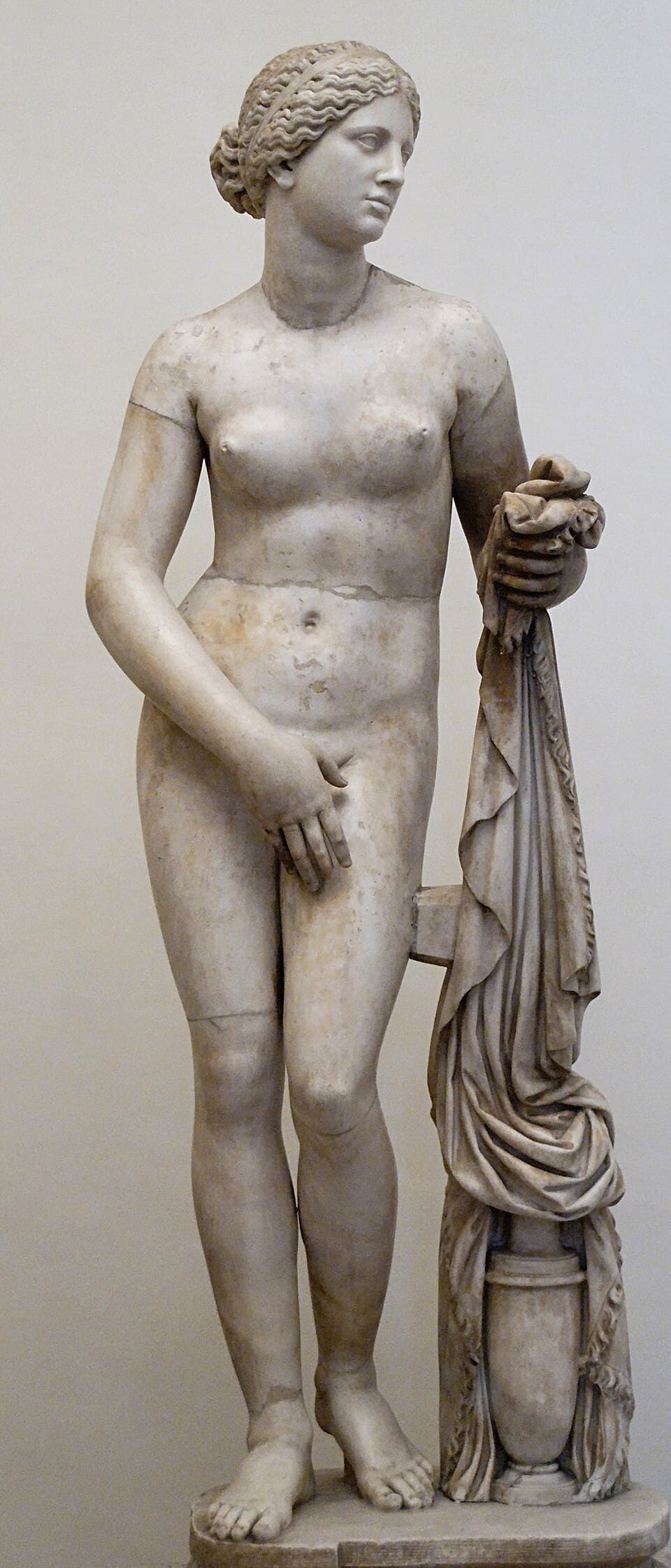
Aphrodite
Aphrodite is an ancient Greek goddess associated with love, lust, beauty, pleasure, passion, procreation, and as her syncretised Roman counterpart Venus, desire, sex, fertility, prosperity, and victory. Aphrodite's major symbols include seashells, myrtles, roses, doves, sparrows, and swans. The cult of Aphrodite may have been derived from the Phoenician goddess Astarte, a cognate of the East Semitic goddess Ishtar, whose cult was based on the Sumerian cult of Inanna. Aphrodite's main cult centers were Cythera, Cyprus, Corinth, and Athens. Her main festival was the Aphrodisia, which was celebrated annually in midsummer. In Laconia, Aphrodite was worshipped as a warrior goddess. She was also the patron goddess of prostitutes, an association which led early scholars to propose the concept of sacred prostitution in Greco-Roman culture, an idea which is now generally seen as erroneous.
Pantheon: Mesopotamian Culture: Sumerian / Akkadian Civilization: Ancient Mesopotamia Period: 3500 BCE – 500 BCE
Source: Wikipedia
Sources & Notes
Wikipedia: https://en.wikipedia.org/wiki/Aphrodite
Discussion
Discussion
No comments yet
Start the discussion — sign in to leave a comment.
Join the Discussion
Join the discussion
Sign in to leave a comment or review.
Sign InorCreate an account