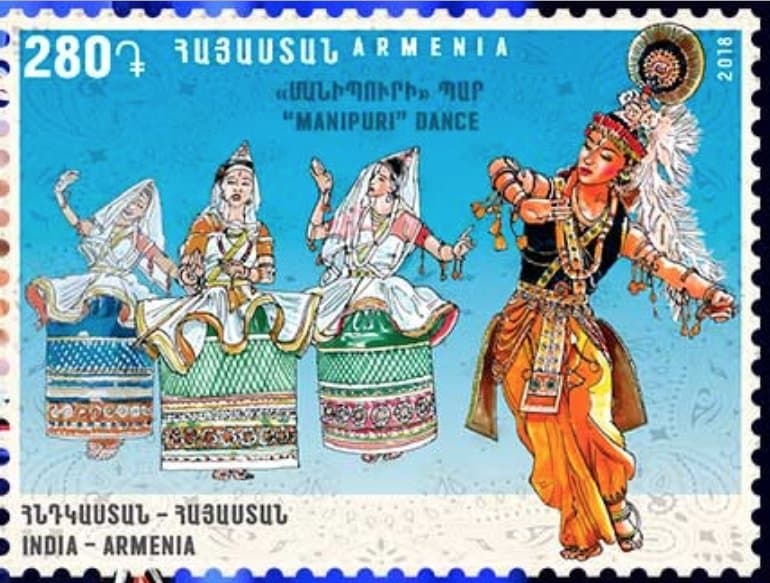
Manipuri dance
Manipuri dance, sometimes also referred to as the Manipuri Raas Leela, is a jagoi and is one of the major Indian classical dance forms, originating from the state of Manipur. It is one of the Meitei intangible cultural heritage. The "Manipuri dance" is a confluence of four ritualistic traditions – Lai Haraoba, Huyen Langlon, Meitei Nata Sankirtana and Raaslila. Owing to the Meitei civilization, the classical dance form, first formally developed by Meitei Hindu king Ching Thang Khomba of the Kingdom of Manipur, is considered to be the highest spiritual expression of the worship of Hindu deity Krishna. The themes of this dance are generally taken from episodes in the life of Krishna. Owing to its huge influences on the diverse cultural heritages across the Indian subcontinent, it is recognised by the Sangeet Natak Akademi of the Ministry of Culture of the Government of India as one of the few primary classical dance forms of the Republic of India, and is honoured with the Sangeet Natak Akademi Award for Manipuri annually. It is referred to as the "national dance" during the Armenia-India joint issue of postage stamps, as a part of the Armenia-India international relations. This dance form was patronized by many Manipuri rulers. In the 20th century, it became a popular dance in Bengal
Pantheon: Hindu Culture: Indian Civilization: Indian subcontinent Period: 1500 BCE – present
Source: Wikipedia
Sources & Notes
Wikipedia: https://en.wikipedia.org/wiki/Manipuri_dance
Discussion
Discussion
No comments yet
Start the discussion — sign in to leave a comment.
Join the Discussion
Join the discussion
Sign in to leave a comment or review.
Sign InorCreate an account