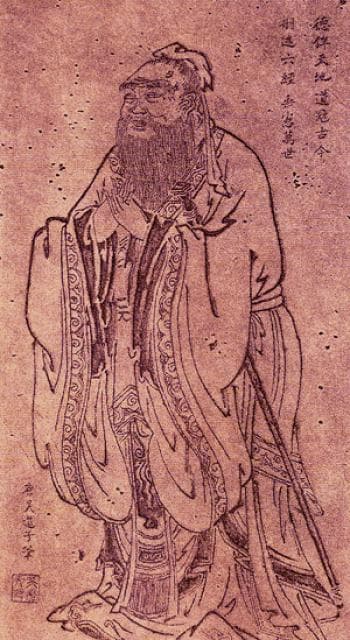
Who He Was
Confucius (c. 551 – c. 479 BCE), born Kong Qiu, was a Chinese philosopher of the Spring and Autumn period who is traditionally considered the paragon of Chinese sages. Much of the shared cultural heritage of the Sinosphere originates in the philosophy and teachings of Confucius. His philosophical teachings, called Confucianism, emphasized personal and governmental morality, harmonious social relationships, righteousness, kindness, sincerity, and a ruler's responsibilities to lead by virtue. Confucius considered himself a transmitter for the values of earlier periods which he claimed had been abandoned in his time. He advocated for filial piety, endorsing strong family loyalty, ancestor veneration, and the respect of elders by their children and of husbands by their wives. Confucius recommended a robust family unit as the cornerstone for an ideal government. He championed the Silver Rule, or a negative form of the Golden Rule, advising, "Do not do unto others what you do not want done to yourself." The time of Confucius's life saw a rich diversity of thought, and was a formative period in China's intellectual history. His ideas gained in prominence during the Warring States period, but experienced setback immediately following the Qin conquest. Under Emperor Wu of Han, Confucius's ideas received official sanction, with affiliated works becoming mandatory readings for career paths leading to officialdom. During the Tang and Song dynasties, Confucianism developed into a system known in the West as Neo-Confucianism. In the 20th century, an intellectual movement emerged in the Republic of China that sought to apply Confucian ideology in a modern context, known as New Confucianism. From ancient dynasties to the modern era, Confucianism has integrated into the Chinese social fabric and way of life. Traditionally, Confucius is credited with having authored or edited many of the ancient texts including all of the Five Classics. However, modern scholars exercise caution in attributing specific assertions to Confucius himself, for at least some of the texts and philosophy associated with him were of a more ancient origin. Aphorisms concerning his teachings were compiled in the Analects, but not until many years after his death. Recognized in: Confucianism.
The founding teacher of Confucianism — a moral sage and reformer rather than a 'prophet' in the religious sense.
Birth and Early Life
Traditional and historical sources place Confucius in the era of 551–479 BCE. Where such dates are traditional, mythic, or disputed rather than historically established, they should be read as the tradition's own reckoning rather than confirmed chronology.
His Calling / Mission
The scriptures and traditions of Confucianism describe the calling and mission of Confucius; the key passages are listed under Sacred Texts and Scripture below.
Religion and Teachings
Confucius is honored within Confucianism. The founding teacher of Confucianism — a moral sage and reformer rather than a 'prophet' in the religious sense. His teaching and significance are set out in the sacred texts that record his life.
Sacred Texts and Scripture
Scriptural references: the Analects and the Confucian classics
Major Accomplishments and Events
The account of Confucius's life, works, and significance is preserved in the scriptures cited above and in the living tradition of Confucianism.
Death and Legacy
Confucius is remembered across Confucianism as one of the foundational figures of faith, and continues to be honored in scripture, devotion, and scholarship. Source: Wikipedia
Scripture References
the Analects and the Confucian classics
Sources & Notes
Wikipedia: https://en.wikipedia.org/wiki/Confucius
Discussion
Discussion
No comments yet
Start the discussion — sign in to leave a comment.
Join the Discussion
Join the discussion
Sign in to leave a comment or review.
Sign InorCreate an account