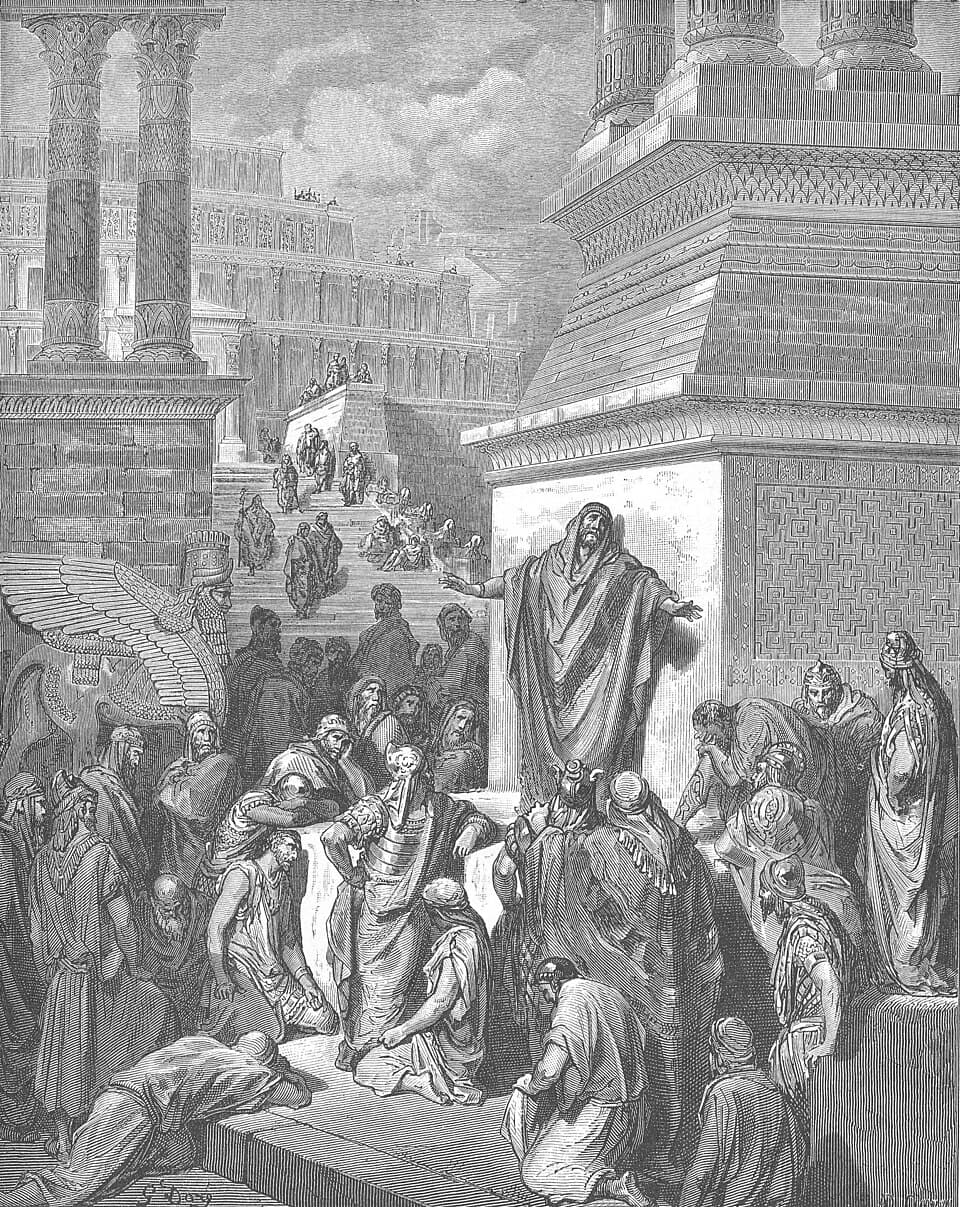
Who He Was
Jonah or Jonas (Hebrew: יוֹנָה Yōnā, lit. 'dove') was a Jewish prophet from Gath-hepher in the Northern Kingdom of Israel around the 8th century BCE according to the Hebrew Bible. He is the central figure of the Book of Jonah, one of the minor prophets, which details his reluctance in delivering the judgment of God to the city of Nineveh (near present-day Mosul) in the Neo-Assyrian Empire. After he is swallowed by a large sea creature (Hebrew: דג גדול, romanized: dāḡ gāḏol, lit. 'large fish') and then released, he returns to the divine mission. In Judaism, the story of Jonah represents the teaching of repentance in Judaism, the ability to repent to God for forgiveness. In the New Testament of Christianity, Jesus calls himself "greater than Jonah" and promises the Pharisees "the sign of Jonah" when referring to his resurrection. Early Christian interpreters viewed Jonah as a type of Jesus. Jonah in Islam is regarded as a prophet and the narrative of Jonah appears in a surah of the Quran named after him, Yūnus. Many modern Bible scholars suggest the Book of Jonah is fictional, and at least partially satirical. Most scholars consider the Book of Jonah to have been composed long after the events it describes due to its use of words and motifs exclusive to postexilic Aramaic sources. The character of Jonah son of Amittai may have been based on the historical prophet of the same name who prophesied during the reign of King Amaziah of Judah, as mentioned in 2 Kings. Although the creature that swallowed Jonah is often depicted in art and culture as a whale, the Hebrew text uses the phrase "large fish". In the 17th century and early 18th century, the species of the fish that swallowed Jonah was the subject of speculation by naturalists, who interpreted the story as an account of a historical incident. Some modern scholars of folklore, on the other hand, note similarities between Jonah and other legendary religious figures, like the Indian yogi Matsyendranatha "Lord of the Fishes", the Sumerian king Gilgamesh, and the Greek hero Jason. Recognized in: Islam, Christianity, Judaism.
Birth and Early Life
Traditional and historical sources place Jonah in the era of c. 8th century BCE. Where such dates are traditional, mythic, or disputed rather than historically established, they should be read as the tradition's own reckoning rather than confirmed chronology.
His Calling / Mission
The scriptures and traditions of Islam, Christianity, Judaism describe the calling and mission of Jonah; the key passages are listed under Sacred Texts and Scripture below.
Religion and Teachings
Jonah is honored within Islam, Christianity, Judaism. His teaching and significance are set out in the sacred texts that record his life.
Sacred Texts and Scripture
Scriptural references: Quran 10:98, 37:139–148, 21:87–88; the Book of Jonah
Major Accomplishments and Events
The account of Jonah's life, works, and significance is preserved in the scriptures cited above and in the living tradition of Islam, Christianity, Judaism.
Death and Legacy
Jonah is remembered across Islam, Christianity, Judaism as one of the foundational figures of faith, and continues to be honored in scripture, devotion, and scholarship. Source: Wikipedia
Scripture References
Quran 10:98, 37:139–148, 21:87–88; the Book of Jonah
Sources & Notes
Wikipedia: https://en.wikipedia.org/wiki/Jonah
Discussion
Discussion
No comments yet
Start the discussion — sign in to leave a comment.
Join the Discussion
Join the discussion
Sign in to leave a comment or review.
Sign InorCreate an account