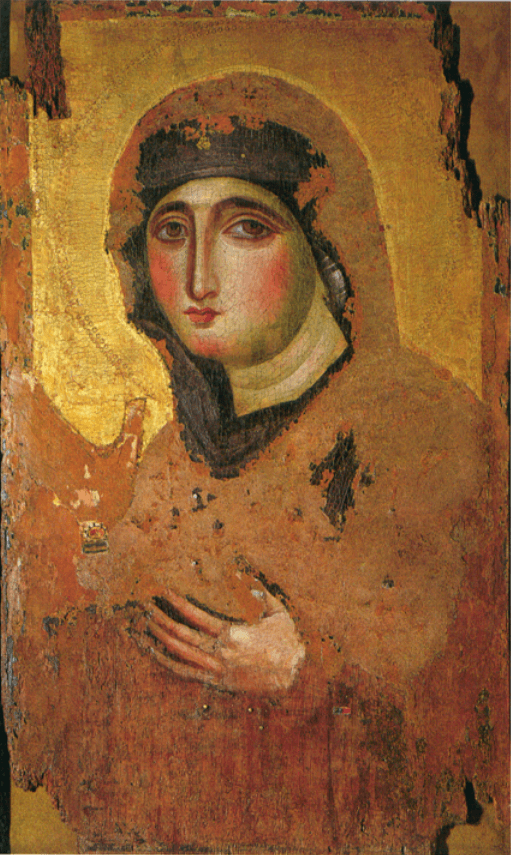
Who She Was
Mary (Arabic: Maryam) is the mother of Jesus (Isa) and one of the most revered women in all of religious history, honored in both Christianity and Islam. She holds the rare distinction of being the only woman mentioned by name in the Quran — where an entire chapter, *Surah 19, is named Maryam after her — while Surah 3 (Āl ʿImrān) recounts her family and birth. In Christianity she is venerated as the mother of Jesus Christ and, in Catholic and Orthodox tradition, as Theotokos* ("God-bearer").
Recognized in: Islam, Christianity.
Birth and Early Life
By tradition Mary was born to Joachim and Anne (in Islamic tradition, to the house of ʿImrān). The Quran relates that her mother dedicated her to God's service while she was still in the womb, and that she was raised in the temple under the guardianship of the prophet Zechariah (Zakariya), who found her miraculously provided for (Quran 3:35–37). Both traditions remember her as exceptionally pure and devout from her earliest years.
The Annunciation and the Virgin Birth
Both Islam and Christianity affirm that Mary conceived Jesus miraculously, as a virgin, by the will and word of God. In the Quran, the angel Gabriel announces to her the birth of a holy son; when she asks how she can bear a child though no man has touched her, she is told that God need only say to a thing "Be," and it is (Quran 19:16–22; 3:45–47). The Gospels recount the same Annunciation: the angel Gabriel tells Mary she will conceive by the Holy Spirit (Luke 1:26–38), and Matthew affirms the virgin conception (Matthew 1:18–25). The virgin birth is thus a profound point of agreement between the two faiths.
Her Role and Status Across Traditions
In Christianity, Mary is the mother of Jesus Christ; Catholic and Orthodox Christians venerate her as Theotokos and hold doctrines such as her perpetual virginity, with Catholicism additionally affirming the Immaculate Conception and the Assumption. In Islam, she is among the most exalted of all human beings: the Quran declares that God "chose her above the women of the worlds" (Quran 3:42) and presents her as a model of faith and chastity for every believer (Quran 66:12). Muslims honor her as a truthful, righteous saint (ṣiddīqah), though not as a prophet.
Sacred Texts and Scripture
Scriptural references: Mary's story is told in the Quran in Surah 19 (Maryam), Surah 3:35–47 (Āl ʿImrān), and Surah 66:12, and in the Bible chiefly in Luke 1–2 and Matthew 1–2.
Major Accomplishments and Events
She is remembered for her unwavering devotion, her acceptance of God's will at the Annunciation, and her bearing and raising of Jesus — events that both traditions treat as among the great signs of God's power and mercy.
Death and Legacy
Mary is among the most beloved and depicted figures in human history — the subject of vast devotion, art, prayer, and theology across Christianity, and of deep reverence in Islam. She stands as a rare and powerful point of shared honor between the two largest faiths on earth.
Source: Wikipedia
Scripture References
Quran 19 (Surah Maryam), 3:35–47, 66:12, 21:91; Luke 1:26–56, Matthew 1:18–25
Sources & Notes
Wikipedia: https://en.wikipedia.org/wiki/Mary%2C_mother_of_Jesus
Discussion
Discussion
No comments yet
Start the discussion — sign in to leave a comment.
Join the Discussion
Join the discussion
Sign in to leave a comment or review.
Sign InorCreate an account