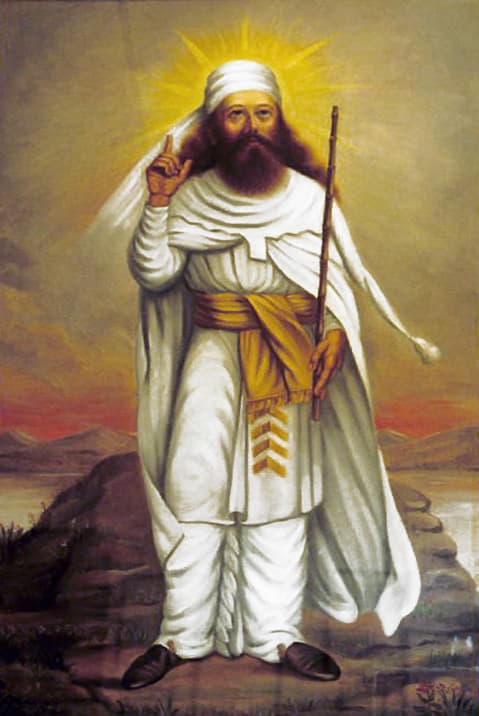
Who He Was
Zarathushtra Spitama, more commonly known as Zoroaster, was an Iranian religious reformer who challenged the tenets of the contemporary Ancient Iranian religion, becoming the spiritual founder of Zoroastrianism. In the oldest Zoroastrian scriptures, the Gathas, which he is traditionally believed to have authored, he is described as a preacher and a poet-prophet. Some have claimed, with much scholarly controversy, to find his influence in Heraclitus, Plato, Pythagoras, and, perhaps less controversially, in the Abrahamic religions, including Judaism, Christianity, and Islam, particularly through concepts of cosmic dualism and personal morality. Zarathustra spoke Avestan, an old Iranian language which scholars lent its name to after the Avesta, the corpus of Zoroastrian religious texts written in the language. Based on this, it is tentative to place his homeland somewhere in the eastern regions of the Greater Iran (possibly Bactra, now in modern-day Afghanistan). His life is traditionally dated to some time around the 7th and 6th centuries BC; though most scholars, using linguistic and socio-cultural evidence, suggest a dating even further back to the end of the 2nd and the beginning of the 1st millennium BC. Zoroastrianism eventually became Greater Iran's most prominent religion from around the 6th century BC, enjoying official sanction during the time of the Sassanid Empire, until the 7th century AD, when the religion was persecuted following the Arab-Muslim conquest of Iran. Zoroaster is credited with authorship of the Gathas as well as the Yasna Haptanghaiti, a series of hymns composed in Old Avestan that cover core Zoroastrian beliefs. Little is known about Zoroaster; most of his life is known only from these scant texts. By modern standards of historiography, no evidence can place him into a fixed period and the historicization surrounding him may be a part of a trend from before the 10th century AD that historicizes legends and myths. His name likely means "he who manages camels", though its etymology has multiple interpretations, and the Greek form "Zoroaster" stems from later transliterations. According to Zoroastrian tradition, Zoroaster was trained as a priest from a young age and, around age 30, experienced a divine revelation which introduced him to Ahura Mazda, the Wise Lord, and the dualism of truth (asha) versus deception (druj). He is said to have gained royal patronage under King Vishtaspa, spread his teachings, and founded a community, marrying three times and having six children. Zoroastrian texts portray his philosophy as emphasizing free will, ethical responsibility, and aligning with asha through good thoughts, words, and deeds. Recognized in: Zoroastrianism.
Birth and Early Life
Traditional and historical sources place Zoroaster in the era of c. 1500–1000 BCE (disputed). Where such dates are traditional, mythic, or disputed rather than historically established, they should be read as the tradition's own reckoning rather than confirmed chronology.
His Calling / Mission
The scriptures and traditions of Zoroastrianism describe the calling and mission of Zoroaster; the key passages are listed under Sacred Texts and Scripture below.
Religion and Teachings
Zoroaster is honored within Zoroastrianism. His teaching and significance are set out in the sacred texts that record his life.
Sacred Texts and Scripture
Scriptural references: the Gathas and the wider Avesta
Major Accomplishments and Events
The account of Zoroaster's life, works, and significance is preserved in the scriptures cited above and in the living tradition of Zoroastrianism.
Death and Legacy
Zoroaster is remembered across Zoroastrianism as one of the foundational figures of faith, and continues to be honored in scripture, devotion, and scholarship. Source: Wikipedia
Scripture References
the Gathas and the wider Avesta
Sources & Notes
Wikipedia: https://en.wikipedia.org/wiki/Zoroaster
Discussion
Discussion
No comments yet
Start the discussion — sign in to leave a comment.
Join the Discussion
Join the discussion
Sign in to leave a comment or review.
Sign InorCreate an account