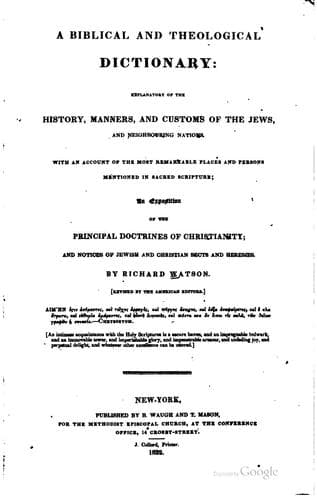
A Biblical and Theological Dictionary: explanatory of the history, manners, and customs of the Jews, and neighbouring nationsWatson, Richard
Religion
A Biblical and Theological Dictionary: explanatory of the history, manners, and customs of the Jews, and neighbouring nations
Watson, Richard
Bible -- Dictionaries; Theology -- Dictionaries
words and sentiments, that the remote or figurative sense is scarcely
permitted to glimmer through it. On the other hand, the figurative sense
is more frequently found to beam forth with so much perspicuity and
lustre, that the literal sense is quite cast into the shade, or becomes
indiscernible. Sometimes the principal or figurative idea is exhibited
to the attentive eye with a constant and equal light; and sometimes it
unexpectedly glares upon us, and breaks forth with sudden and
astonishing coruscations, like a flash of lightning bursting from the
clouds. But the mode or form of this figure which possesses the chief
beauty and elegance, is, when the two images, equally conspicuous, run,
as it were, parallel throughout the whole poem, mutually illustrating
and correspondent to each other. The learned author has illustrated
these observations by instances selected from Psalms ii, and lxxii. He
adds, that the mystical allegory is, on account of the obscurity
resulting from the nature of the figure, and the style of the
composition, so agreeable to the nature of the prophecy, that it is the
form which it generally, and indeed lawfully, assumes, as best adapted
to the prediction of future events. It describes events in a manner
exactly conformable to the intention of prophecy; that is, in a dark,
disguised, and intricate manner, sketching out, in a general way, their
form and outline; and seldom descending to a minuteness of description
and exactness of detail.
ALLELUIA, or HALLELU-JAH, הללו־יה, _praise the Lord_; or, _praise to the
Lord_: compounded of הללו, _praise ye_, and יה, _the Lord_. This word
occurs at the beginning, or at the end, of many Psalms. Alleluia was
sung on solemn days of rejoicing: “And all her streets shall sing
Alleluia,” says Tobit, speaking of the rebuilding of Jerusalem, Tob.
xiii, 18. St. John, in the Revelation, xix, 1, 3, 4, 6, says, “I heard a
great voice of much people in heaven, who cried, Alleluia; and the four
living creatures fell down, and worshipped God, saying, Alleluia.” This
expression of joy and praise was transferred from the synagogue to the
church. At the funeral of Fabiola, “several psalms were sung with loud
alleluias,” says Jerom, in _Epitaphio Paulæ_, “The monks of Palestine
were awaked at their midnight watchings, with the singing of alleluias.”
It is still occasionally used in devotional psalmody.
Public-domain text, read in full here on John Shaqi.
Reviews
Reviews
No reviews yet
Be the first to share your thoughts on this work.
Elsewhere in the archive
Join the Discussion
Join the discussion
Sign in to leave a comment or review.
Sign InorCreate an account