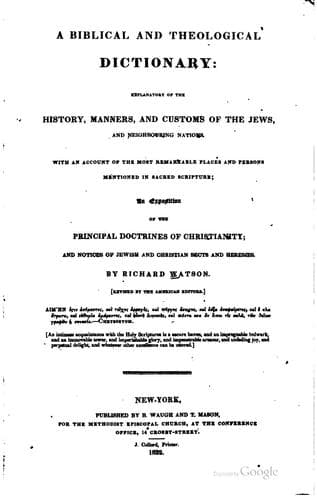
A Biblical and Theological Dictionary: explanatory of the history, manners, and customs of the Jews, and neighbouring nationsWatson, Richard
Religion
A Biblical and Theological Dictionary: explanatory of the history, manners, and customs of the Jews, and neighbouring nations
Watson, Richard
Bible -- Dictionaries; Theology -- Dictionaries
It is probable that the rods which the princes of Israel bore, were
scions of the almond tree, at once the ensign of their office, and the
emblem of their vigilance. Such, we know from the testimony of
Scripture, was the rod of Aaron; which renders it exceedingly probable,
that the rods of the other chiefs were from the same tree.
The hoary head is beautifully compared by Solomon to the almond tree,
covered in the earliest days of spring with its snow white flowers,
before a single leaf has budded: “The almond tree shall flourish, and
the grasshopper shall be a burden, and desire shall fail,” Eccl. xii, 5.
Man has existed in this world but a few days, when old age begins to
appear, sheds its snows upon his head, prematurely nips his hopes,
darkens his earthly prospects, and hurries him into the grave.
ALMUG TREE, a certain kind of wood, mentioned 1 Kings, x, 11; 2 Chron.
ii, 8; ix, 10, 11. Jerom and the Vulgate render it, _ligna thyina_, and
the Septuagint ξύλα ϖελεκητὰ, _wrought wood_. Several critics understand
it to mean _gummy wood_; but a wood abounding in resin must be very
unfit for the uses to which this is said to be applied. Celsus queries
if it be not the sandal; but Michaelis thinks the particular species of
wood to be wholly unknown to us. Dr. Shaw supposes that the almug tree
was the cypress; and he observes that the wood of this tree is still
used in Italy and other places for violins, harpsichords, and other
stringed instruments.
ALOE, עלר, a plant with broad leaves, nearly two inches thick, prickly
and serrated. It grows about two feet high. A very bitter gum is
extracted from it, used for medicinal purposes, and anciently for
embalming dead bodies. Nicodemus is said, John xix, 39, to have brought
one hundred pounds’ weight of myrrh and aloes to embalm the body of
Jesus. The quantity has been exclaimed against by certain Jews, as being
enough for fifty bodies. But instead of ἑκατὸν it might originally have
been written δέκατον, _ten_ pounds’ weight. However, at the funeral of
Herod there were five hundred ἀρωματόφορους, _spice bearers_; and at
that of R. Gamaliel, eighty pounds of opobalsamum were used.
Public-domain text, read in full here on John Shaqi.
Reviews
Reviews
No reviews yet
Be the first to share your thoughts on this work.
Elsewhere in the archive
Join the Discussion
Join the discussion
Sign in to leave a comment or review.
Sign InorCreate an account