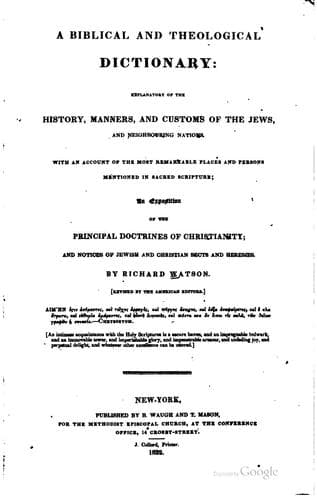
A Biblical and Theological Dictionary: explanatory of the history, manners, and customs of the Jews, and neighbouring nationsWatson, Richard
Religion
A Biblical and Theological Dictionary: explanatory of the history, manners, and customs of the Jews, and neighbouring nations
Watson, Richard
Bible -- Dictionaries; Theology -- Dictionaries
The wood which God showed Moses, that with it he might sweeten the
waters of Marah, is called _alvah_, Exod. xv, 25. The word has some
relation to aloe; and some interpreters are of opinion that Moses used a
bitter sort of wood, that so the power of God might be the more
remarkable. Mr. Bruce mentions a town, or large village, by the name of
Elvah. It is thickly planted with trees; is the _oasis parva_ of the
ancients; and the last inhabited place to the west that is under the
jurisdiction of Egypt. He also observes that the Arabs call a shrub or
tree, not unlike our hawthorn, either in wood or flower, by the name of
elvah. “It was this,” say they, “with which Moses sweetened the waters
of Marah; and with this, too, did Kalib Ibn el Walid sweeten those of
Elvah, once bitter, and give the place the name of this circumstance.”
It may be that God directed Moses to the very wood proper for the
purpose. M. Neibuhr, when in these parts, inquired after wood capable of
this effect, but could gain no information of any such. It will not,
however, from hence follow that Moses really used a bitter wood; but, as
Providence usually works by the proper and fit means to accomplish its
ends, it seems likely that the wood he made use of was, in some degree
at least, corrective of that quality which abounded in the water, and so
rendered it potable. This seems to have been the opinion of the author
of Ecclesiasticus, xxxviii, 5. That other water, also, requires some
correction, and that such a correction is applied to it, appears from
the custom in Egypt in respect to that of the Nile, which, though
somewhat muddy, is rendered pure and salutary by being put into jars,
the inside of which is rubbed with a paste made of bitter almonds. The
first discoverers of the Floridas are said to have corrected the
stagnant and fetid water they found there, by infusing in it branches of
sassafras; and it is understood that the first inducement of the Chinese
to the general use of tea, was to correct the water of their ponds and
rivers.
Public-domain text, read in full here on John Shaqi.
Reviews
Reviews
No reviews yet
Be the first to share your thoughts on this work.
Elsewhere in the archive
Join the Discussion
Join the discussion
Sign in to leave a comment or review.
Sign InorCreate an account