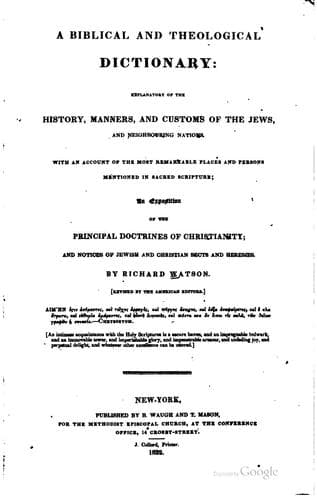
A Biblical and Theological Dictionary: explanatory of the history, manners, and customs of the Jews, and neighbouring nationsWatson, Richard
Religion
A Biblical and Theological Dictionary: explanatory of the history, manners, and customs of the Jews, and neighbouring nations
Watson, Richard
Bible -- Dictionaries; Theology -- Dictionaries
The Amalekites were indeed the earliest and the most bitter enemies the
Jews had to encounter. They attacked them in the desert; and sought
every opportunity afterward of molesting them. Under the judges, the
Amalekites, in conjunction with the Midianites, invaded the land of
Israel; when they were defeated by Gideon, Judges vi, vii. But God, for
their first act of treachery, had declared that he would “utterly put
out the remembrance of Amalek from under heaven;” a denunciation which
was not long after accomplished. Saul destroyed their entire army, with
the exception of Agag their king; for sparing whom, and permitting the
Israelites to take the spoil of their foes, he incurred the displeasure
of the Lord, who took the sceptre from him. Agag was immediately
afterward hewn in pieces by Samuel, 1 Sam. xv. It is remarkable, that
most authors make Saul’s pursuit of the Amalekites to commence from the
lower Euphrates, instead of from the southern border of the land of
Canaan. (See _Havilah_.) David a few years after, defeated another of
their armies; of whom only four hundred men escaped on camels, 1 Sam.
xxx; after which event, the Amalekites appear to have been obliterated
as a nation.
AMASA, the son of Ithra and Abigail, David’s sister, whom Absalom, when
he rebelled against his father, appointed general of his army, 2 Sam.
xvii, 25. Amasa having thus received the command of Absalom’s troops,
engaged his cousin Joab, general of David’s army, and was worsted. But,
after the defeat of Absalom’s party, David, being angry at Joab for
killing Absalom, pardoned Amasa, and gave him the command of his own
army. Upon the revolt of Sheba, the son of Bichri, David gave orders to
Amasa to assemble all Judah and march against Sheba. Amasa not being
able to form his army in the time prescribed, David directed Abishai to
pursue Sheba with the guards. Joab, with his people, accompanied him;
and these troops were scarcely got as far as the great stone in Gibeon,
before Amasa came and joined them with his forces. Then said Joab to
Amasa, “Art thou in health, my brother?” and took him by the beard with
his right hand to kiss him; and treacherously smote him under the fifth
rib, so that he expired.
AMAZIAH, one of the kings of Judah, 2 Chron. xxiv, 27, son of Joash,
succeeded his father A. M. 3165, B. C. 839. He was twenty-five years of
age when he began to reign, and reigned twenty-nine years at Jerusalem.
“He did good in the sight of the Lord, but not with a perfect heart.”
When settled in his kingdom, he put to death the murderers of his
father, but avoided a barbarous practice then too common, to destroy
also their children; in which he had respect to the precept, “The
fathers shall not be put to death for the children, neither shall the
children be put to death for the fathers; every man shall be put to
death for his own sin,” Deut. xxiv, 16; 2 Chron. xxv, 1–3.
Public-domain text, read in full here on John Shaqi.
Reviews
Reviews
No reviews yet
Be the first to share your thoughts on this work.
Elsewhere in the archive
Join the Discussion
Join the discussion
Sign in to leave a comment or review.
Sign InorCreate an account