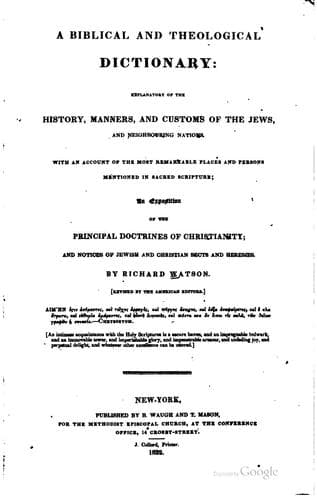
A Biblical and Theological Dictionary: explanatory of the history, manners, and customs of the Jews, and neighbouring nationsWatson, Richard
Religion
A Biblical and Theological Dictionary: explanatory of the history, manners, and customs of the Jews, and neighbouring nations
Watson, Richard
Bible -- Dictionaries; Theology -- Dictionaries
This indignity was punished by David with
rigour. Rabbah, the capital of Hanun, and the other cities of Ammon,
which resisted the progress of the conqueror, were destroyed and razed
to the ground; and the inhabitants were put to death or reduced to
servitude. In the reign of Jehoshaphat the Ammonites united with their
brethren, the Moabites, and the inhabitants of Mount Seir, against the
king of Judah; but they were completely routed. They were afterward
overthrown by Uzziah, king of Judah, and made tributary, 2 Chron. xxvi,
8; and rebelling in the reign of his son Jotham, they were reduced to
the necessity of purchasing peace at a very dear rate. After the tribes
of Reuben, Gad, and the half tribe of Manasseh, were carried into
captivity by Tiglath Pileser, B. C. 740, the Ammonites and Moabites took
possession of the cities belonging to these tribes, and were reproached
for it by Jeremiah, xlix, 1. Their ambassadors were exhorted to submit
to Nebuchadnezzar, and threatened, on their refusal, with captivity and
slavery, Jer. xxvii, 2, 3, 4. The Prophet Ezekiel, xxv, 4–10, denounces
their entire destruction, and informs them, that God would deliver them
up to the people of the east; and that the Ammonites should no more be
mentioned among the nations: and this punishment they were to suffer for
insulting the Israelites on account of their calamities, and the
destruction of their temple by the Chaldeans. This malediction began to
be inflicted upon them in the fifth year after the taking of Jerusalem,
when Nebuchadnezzar made war against all the people around Judea, A. M.
3420 or 3421, B. C. 583. It is probable that Cyrus granted to the
Ammonites and Moabites liberty to return into their own country, whence
they had been removed by Nebuchadnezzar; for they were exposed to the
revolutions that were common to the people of Syria and Palestine, and
were subject sometimes to the kings of Egypt, and sometimes to the kings
of Syria. Polybius informs us, that Antiochus the Great took Rabboth, or
Philadelphia, the capital of the Ammonites, demolished the walls, and
put a garrison into it, A. M. 3806, B. C. 198. During the persecutions
of Antiochus Epiphanes, the Ammonites manifested their hatred to the
Jews, and exercised great cruelties against such of them as lived in
their parts. At length their city Jaser, and the neighbouring town, fell
a prey to the Jews, who smote the men, carried their wives and children
into captivity, and plundered and burned the city. Thus ended their last
conflict with the descendants of Israel. Ammon was, however, a highly
productive and populous country when the Romans became masters of all
the provinces of Syria; and several of the ten allied cities, which gave
name to the celebrated Decapolis, were included within its boundaries.
Even when first invaded by the Saracens, this country, including Moab,
was enriched by the various benefits of trade, covered with a line of
forts, and possessed some strong and populous cities.
Public-domain text, read in full here on John Shaqi.
Reviews
Reviews
No reviews yet
Be the first to share your thoughts on this work.
Elsewhere in the archive
Join the Discussion
Join the discussion
Sign in to leave a comment or review.
Sign InorCreate an account