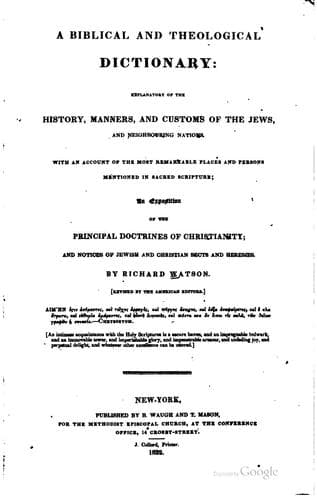
A Biblical and Theological Dictionary: explanatory of the history, manners, and customs of the Jews, and neighbouring nationsWatson, Richard
Religion
A Biblical and Theological Dictionary: explanatory of the history, manners, and customs of the Jews, and neighbouring nations
Watson, Richard
Bible -- Dictionaries; Theology -- Dictionaries
Volney bears
witness, “that in the immense plains of the Hauran, ruins are
continually to be met with, and that what is said of its actual
fertility perfectly corresponds with the idea given of it in the Hebrew
writings.” The fact of its natural fertility is corroborated by every
traveller who has visited it. And “it is evident,” says Burckhardt,
“that the whole country must have been extremely well cultivated in
order to have afforded subsistence to the inhabitants of so many towns,”
as are now visible only in their ruins. While the fruitfulness of the
land of Ammon, and the high degree of prosperity and power in which it
subsisted long prior and long subsequent to the date of the predictions,
are thus indisputably established by historical evidence and by existing
proofs, the researches of recent travellers (who were actuated by the
mere desire of exploring these regions and obtaining geographical
information) have made known its present aspect; and testimony the most
clear, unexceptionable, and conclusive, has been borne to the state of
dire desolation to which it is and has long been reduced.
It was prophesied concerning Ammon, “Son of man, set thy face against
the Ammonites, and prophesy against them. I will make Rabbah of the
Ammonites a stable for camels and a couching place for flocks. Behold, I
will stretch out my hand upon thee, and deliver thee for a spoil to the
Heathen; I will cut thee off from the people, and cause thee to perish
out of the countries; I will destroy thee. The Ammonites shall not be
remembered among the nations. Rabbah” (the chief city) “of the Ammonites
shall be a desolate heap. Ammon shall be a perpetual desolation,” Ezek.
xxv, 2, 5, 7, 10; xxi, 32; Jer. xlix, 2; Zeph. ii, 9.
Public-domain text, read in full here on John Shaqi.
Reviews
Reviews
No reviews yet
Be the first to share your thoughts on this work.
Elsewhere in the archive
Join the Discussion
Join the discussion
Sign in to leave a comment or review.
Sign InorCreate an account