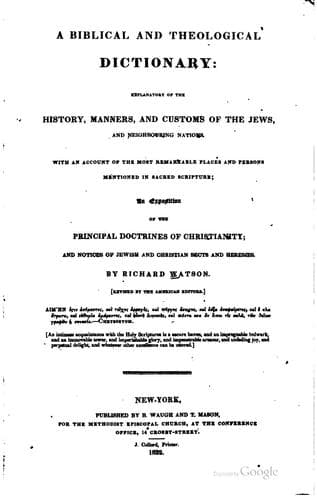
A Biblical and Theological Dictionary: explanatory of the history, manners, and customs of the Jews, and neighbouring nationsWatson, Richard
Religion
A Biblical and Theological Dictionary: explanatory of the history, manners, and customs of the Jews, and neighbouring nations
Watson, Richard
Bible -- Dictionaries; Theology -- Dictionaries
Ammon was to be delivered to be a spoil to the Heathen--to be destroyed,
and to be a perpetual desolation. “All this country, formerly so
populous and flourishing, is now changed into a vast desert.”
(_Seetzen’s Travels._) Ruins are seen in every direction. The country is
divided between the Turks and the Arabs, but chiefly possessed by the
latter. The extortions of the one, and the depredations of the other,
keep it in “perpetual desolation,” and make it “a spoil to the Heathen.”
“The far greater part of the country is uninhabited, being abandoned to
the wandering Arabs, and the towns and villages are in a state of total
ruin.” (_Ibid._) “At every step are to be found the vestiges of ancient
cities, the remains of many temples, public edifices, and Greek
churches.” (_Burckhardt’s Travels._) The cities are left desolate. “Many
of the ruins present no objects of any interest. They consist of a few
walls of dwelling houses, heaps of stones, the foundations of some
public edifices, and a few cisterns filled up; there is nothing entire,
though it appears that the mode of building was very solid, all the
remains being formed of large stones. In the vicinity of Ammon there is
a fertile plain interspersed with low hills, which for the greater part
are covered with ruins.” (_Burckhardt’s Travels in Syria._) While the
country is thus despoiled and desolate, there are valleys and tracts
throughout it which “are covered with a fine coat of verdant pasture,
and are places of resort to the Bedouins, where they pasture their
camels and their sheep.” (_Buckingham’s Travels in Palestine._) “The
whole way we traversed,” says Seetzen, “we saw villages in ruins, and
met numbers of Arabs with their camels,” &c. Mr. Buckingham describes a
building among the ruins of Ammon, “the masonry of which was evidently
constructed of materials gathered from the ruins of other and older
buildings on the spot. On entering it at the south end,” he adds, “we
came to an open square court, with arched recesses on each side, the
sides nearly facing the cardinal points. The recesses in the northern
and southern wall were originally open passages, and had arched door
ways facing each other; but the first of these was found wholly closed
up, and the last was partially filled up, leaving only a narrow passage,
just sufficient for the entrance of one man and of the goats, which the
Arab keepers drive in here occasionally for shelter during the night.”
He relates that he lay down among “flocks of sheep and goats,” close
beside the ruins of Ammon; and particularly remarks that, during the
night, he “was almost entirely prevented from sleeping by the bleating
of flocks.” So literally true is it, although Seetzen, and Burckhardt,
and Buckingham, who relate the facts, make no reference or allusion
whatever to any of the prophecies, and travelled for a different object
than the elucidation of the Scriptures,--that “the chief city of the
Public-domain text, read in full here on John Shaqi.
Reviews
Reviews
No reviews yet
Be the first to share your thoughts on this work.
Elsewhere in the archive
Join the Discussion
Join the discussion
Sign in to leave a comment or review.
Sign InorCreate an account