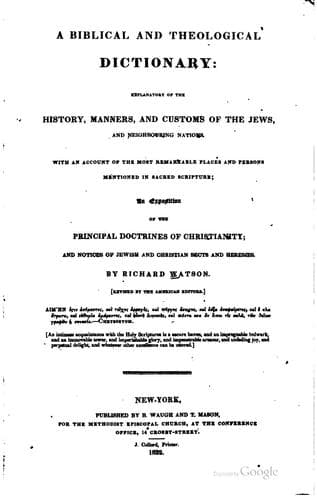
A Biblical and Theological Dictionary: explanatory of the history, manners, and customs of the Jews, and neighbouring nationsWatson, Richard
Religion
A Biblical and Theological Dictionary: explanatory of the history, manners, and customs of the Jews, and neighbouring nations
Watson, Richard
Bible -- Dictionaries; Theology -- Dictionaries
Ammonites is a stable for camels, and a couching place for flocks.”
“The Ammonites shall not be remembered among the nations.” While the
Jews, who were long their hereditary enemies, continue as distinct a
people as ever, though dispersed among all nations, no trace of the
Ammonites remains; none are now designated by their name, nor do any
claim descent from them. They did exist, however, long after the time
when the eventual annihilation of their race was foretold; for they
retained their name, and continued a great multitude until the second
century of the Christian æra. (_Justin Martyr._) “Yet they are cut off
from the people. Ammon has perished out of the countries; it is
destroyed.” No people is attached to its soil; none regard it as their
country and adopt its name: “And the Ammonites are not remembered among
the nations.”
“Rabbah” (Rabbah Ammon, the chief city of Ammon) “shall be a desolate
heap.” Situated, as it was, on each side of the borders of a plentiful
stream, encircled by a fruitful region, strong by nature and fortified
by art, nothing could have justified the suspicion, or warranted the
conjecture in the mind of an uninspired mortal, that the royal city of
Ammon, whatever disasters might possibly befal it in the fate of war or
change of masters, would ever undergo so total a transmutation as to
become a desolate heap. But although, in addition to such tokens of its
continuance as a city, more than a thousand years had given
uninterrupted experience of its stability, ere the prophets of Israel
denounced its fate; yet a period of equal length has now marked it out,
as it exists to this day, a desolate heap, a perpetual or permanent
desolation. Its ancient name is still preserved by the Arabs, and its
site is now “covered with the ruins of private buildings--nothing of
them remaining except the foundations and some of the door posts. The
buildings, exposed to the atmosphere, are all in decay,” (_Burckhardt’s
Travels in Syria_,) so that they may be said literally to form a
desolate heap. The public edifices, which once strengthened or adorned
the city, after a long resistance to decay, are now also desolate; and
the remains of the most entire among them, subjected as they are to the
abuse and spoliation of the wild Arabs, can be adapted to no better
object than “a stable for camels.” Yet these broken walls and ruined
palaces, says Mr. Keith, which attest the ancient splendour of Ammon,
can now be made subservient, by means of a single act of reflection, to
a far nobler purpose than the most magnificent edifices on earth can be,
when they are contemplated as monuments on which the historic and
prophetic truth of Scripture is blended in one bright inscription.
Public-domain text, read in full here on John Shaqi.
Reviews
Reviews
No reviews yet
Be the first to share your thoughts on this work.
Elsewhere in the archive
Join the Discussion
Join the discussion
Sign in to leave a comment or review.
Sign InorCreate an account