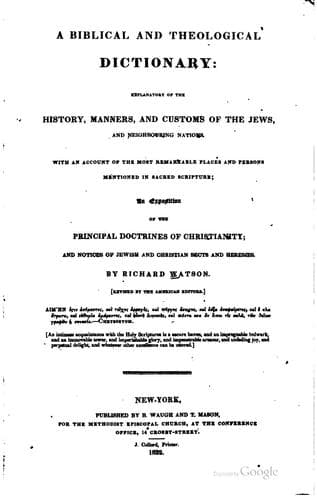
A Biblical and Theological Dictionary: explanatory of the history, manners, and customs of the Jews, and neighbouring nationsWatson, Richard
Religion
A Biblical and Theological Dictionary: explanatory of the history, manners, and customs of the Jews, and neighbouring nations
Watson, Richard
Bible -- Dictionaries; Theology -- Dictionaries
AMORITES, the descendants of Amori, or Hæmorri, or Amorrhæus, Gen. x,
16, the fourth son of Canaan, whose first possessions were in the
mountains of Judea, among the other families of Canaan: but, growing
strong above their fellows, and impatient of confinement within the
narrow boundaries of their native district, they passed the Jordan, and
extended their conquests over the finest provinces of Moab and Ammon;
seizing and maintaining possession of that extensive and almost
insulated portion of country included between the rivers Jordan, Jabbok,
and Arnon. This was the kingdom, and Heshbon the capital, of the
Amorites, under Sihon their king, when the Israelites, in their way from
Egypt, requested a passage through their country. This request, however,
Sihon refused; and came out against them with all his force, when he was
slain, his people extirpated, and his kingdom taken possession of by the
Israelites. It was subsequently divided between the tribes of Reuben and
Gad, Num. xiii, 29; xxi, 13, 25; Joshua v, 1; xi, 3; Judges xi, 19, 22.
AMOS, the fourth of the minor prophets, who in his youth had been a
herdsman in Tekoa, a small town about four leagues southward of
Jerusalem. He was sent to the people of Samaria, to bring them back to
God by repentance, and reformation of manners. Hence it is natural to
suppose that he must have been born within the territories of Israel,
and that he only retired to Tekoa, on being expelled from Bethel by
Amaziah, the priest of the calves at Bethel. He frequently complains of
the violence offered him by those who endeavoured to impose silence on
him. He boldly inveighs against the crying sins of the Israelites, such
as idolatry, oppression, wantonness, and obstinacy. Nor does he spare
the sins of Judah, such as their carnal security, sensuality, and
injustice. He utters frequent threatenings against them both, and
predicts their ruin. It is observable in this prophecy, that, as it
begins with denunciations of judgment and destruction against the
Syrians, Philistines, Tyrians, and other enemies of the Jews, so it
concludes with comfortable promises of the restoration of the tabernacle
of David, and the establishment of the kingdom of Christ. Amos was
called to the prophetic office in the time of Uzziah, king of Judah, and
Jeroboam, the son of Joash, king of Israel.
Public-domain text, read in full here on John Shaqi.
Reviews
Reviews
No reviews yet
Be the first to share your thoughts on this work.
Elsewhere in the archive
Join the Discussion
Join the discussion
Sign in to leave a comment or review.
Sign InorCreate an account