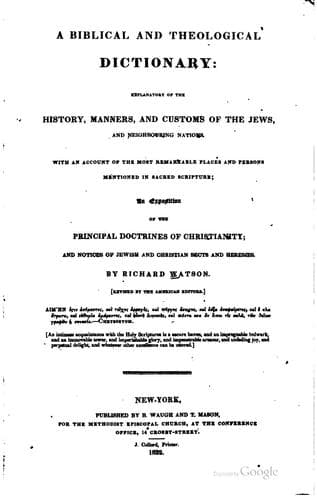
A Biblical and Theological Dictionary: explanatory of the history, manners, and customs of the Jews, and neighbouring nationsWatson, Richard
Religion
A Biblical and Theological Dictionary: explanatory of the history, manners, and customs of the Jews, and neighbouring nations
Watson, Richard
Bible -- Dictionaries; Theology -- Dictionaries
Some writers, in adverting to the condition of Amos, have, with a minute
affectation of criticism, pretended to discover a certain rudeness and
vulgarity in his style; and even Jerom is of opinion that he is
deficient in magnificence and sublimity. He applies to him the words
which St. Paul speaks of himself, that he was rude in speech, though not
in knowledge; and his authority, says Bishop Lowth, “has influenced many
commentators to represent him as entirely rude, and void of elegance;
whereas it requires but little attention to be convinced that he is not
a whit behind the very chiefest of the prophets;” equal to the greatest
in loftiness of sentiment, and scarcely inferior to any in the splendour
of his diction, and in the elegance of his composition. Mr. Locke has
observed, that his comparisons are chiefly drawn from lions, and other
animals, because he lived among, and was conversant with, such objects.
But, indeed, the finest images and allusions, which adorn the poetical
parts of Scripture, in general are drawn from scenes of nature, and from
the grand objects that range in her walks; and true genius ever delights
in considering these as the real sources of beauty and magnificence. The
whole book of Amos is animated with a fine and masculine eloquence.
AMULET, a charm or supposed preservative against diseases, witchcraft,
or any other mischief. They were very frequent among the Jews, the
Greeks, and the Romans, and were made of stone, metal, animal
substances, or, in short, any thing which a weak imagination suggested.
The Jews were very superstitious in the use of amulets, but the Mishna
forbids them, unless received from some person of whose cures, at least,
three instances could be produced. The phylacteries worn by the
Pharisees and others of the Jewish nation were a sort of amulets.
Amulets among the Greeks were called, φυλακτήρια, περιάπτα,
ἀποτέλεσματα, περιάμματα, βρήβια, and εξκόλπια. The Latins called them
_amuleta, appensa, pentacula, &c._ Remains of this superstition continue
among ignorant people even in this country, which ought to be strongly
discountenanced as weak or wicked. The word amulet is probably derived
from _amula_, a small vessel with lustral water in it, anciently carried
in the pocket for the sake of purification and expiation.
Public-domain text, read in full here on John Shaqi.
Reviews
Reviews
No reviews yet
Be the first to share your thoughts on this work.
Elsewhere in the archive
Join the Discussion
Join the discussion
Sign in to leave a comment or review.
Sign InorCreate an account