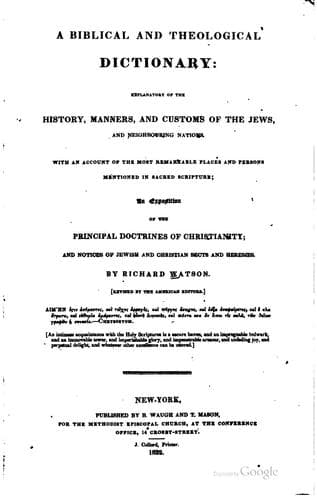
A Biblical and Theological Dictionary: explanatory of the history, manners, and customs of the Jews, and neighbouring nationsWatson, Richard
Religion
A Biblical and Theological Dictionary: explanatory of the history, manners, and customs of the Jews, and neighbouring nations
Watson, Richard
Bible -- Dictionaries; Theology -- Dictionaries
AMYRALDISM, a name given by some writers to the doctrine of universal
grace, as explained and asserted by Amyraldus, or Moses Amyraut, and his
followers, among the reformed in France, toward the middle of the
seventeenth century. This doctrine principally consisted of the
following particulars, viz. that God desires the happiness of all men,
from which none are excluded by a divine decree; that none can obtain
salvation without faith in Christ; that God refuses to none the power of
believing, though he does not grant to all his assistance, that they may
improve this power to saving purposes; and that many perish through
their own fault. Those who embraced this doctrine were called
Universalists, although, it is evident that they rendered grace
universal in words, but partial in reality, and are chargeable with
greater inconsistencies than the Supralapsarians. Amyraldus is said to
have formed his system with a view of producing a reconciliation between
the Lutherans and Calvinists. This theory was supported in England by
Baxter. See BAXTERIANISM.
ANABAPTISTS, a name given to those Christians who maintain that baptism
ought always to be performed by immersion; that it ought not to be
administered to children before the age of discretion; and that at this
age it ought to be readministered to those who have been baptized in
their infancy. They affirm that the administration of this sacrament is
neither valid nor useful, if it be done by sprinkling only, and not by
immersion; or if the persons who receive it be not in a condition to
give the reasons of their belief. The Anabaptists of Germany brought the
name into great odium by their turbulent conduct; but by the people of
this persuasion generally, the conduct of these fanatics was at all
times condemned. In England they form a most respectable, though not a
very numerous body.
The word Anabaptist is compounded of ἀνὰ, new, and βαπτιϛὴς, a baptist;
and has been indiscriminately applied to people of very different
principles. Many of them object to the name, because the baptism of
infants by sprinkling is, in their opinion, no baptism; and others hold
nothing in common excepting some one or other of the above mentioned
opinions concerning baptism. See BAPTISM.
ANAGOGICAL. This is one of the four senses in which Scripture may be
interpreted, viz. the literal, allegorical, anagogical, and
tropological. The anagogical sense is given when the text is explained
with regard to the end which Christians should have in view, that is,
eternal life: for example, the rest of the Sabbath, in the anagogical
sense, corresponds to the repose of everlasting blessedness.
Public-domain text, read in full here on John Shaqi.
Reviews
Reviews
No reviews yet
Be the first to share your thoughts on this work.
Elsewhere in the archive
Join the Discussion
Join the discussion
Sign in to leave a comment or review.
Sign InorCreate an account