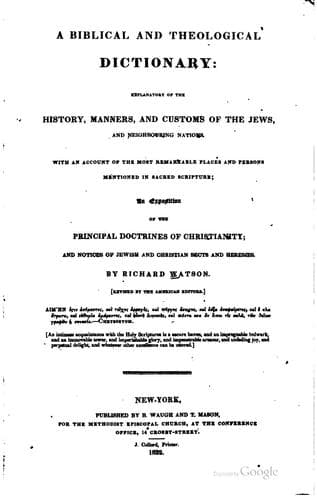
A Biblical and Theological Dictionary: explanatory of the history, manners, and customs of the Jews, and neighbouring nationsWatson, Richard
Religion
A Biblical and Theological Dictionary: explanatory of the history, manners, and customs of the Jews, and neighbouring nations
Watson, Richard
Bible -- Dictionaries; Theology -- Dictionaries
ANAK, ANAKIM, famous giants in Palestine. Anak, father of the Anakim,
was son of Arba, who gave his name to Kirjath-Arba, or Hebron. Anak had
three sons, Sheshai, Ahiman, and Talmai, whose descendants were terrible
for their fierceness and stature. The Hebrew spies reported that in
comparison of those monstrous men, they themselves were but
grasshoppers. Some have thought that the name _Phœnician_, given to
the Canaanites, and particularly to the Sidonians, was originally from
_Bene-Anak_, sons of Anak. Caleb, assisted by the tribe of Judah, took
Kirjath-Arba, and destroyed the Anakim, A. M. 2559. Josh. xv, 14; Judg.
i, 20.
ANALOGY OF FAITH. This has been often and largely descanted upon as an
important rule for interpreting Scripture, founded, as it is said, upon
Rom. xii, 6, “Let us prophesy according to the proportion” (_analogy_)
“of faith.”
The principle of this rule has been thus stated: It is evident the
Almighty doth not act without a design in the system of Christianity,
any more than in the works of nature. Now this design must be uniform;
for as in the system of the universe every part is proportioned to the
whole, and made subservient to it,--so, in the system of the Gospel, all
the various truths, doctrines, declarations, precepts, and promises must
correspond with, and tend to, the end designed. For instance, supposing
the glory of God in the salvation of sinners by free grace be the grand
design,--then, whatever doctrine, assertion, or hypothesis agrees not
with this, it is to be considered as false. The effect however of this
view of the case appears to be often delusive. If nothing more be meant
than that, what is obscure in a revelation should be interpreted by that
which is plain, the same rule applies to all sober interpretations of
any book whatever; but if we call our opinions, perhaps hastily taken
up, or admitted on some authority without examination by the light of
Scripture, “the analogy of faith,” we shall greatly err. On this subject
Dr. Campbell remarks:--
Public-domain text, read in full here on John Shaqi.
Reviews
Reviews
No reviews yet
Be the first to share your thoughts on this work.
Elsewhere in the archive
Join the Discussion
Join the discussion
Sign in to leave a comment or review.
Sign InorCreate an account