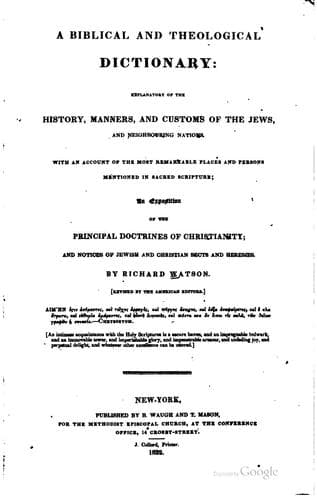
A Biblical and Theological Dictionary: explanatory of the history, manners, and customs of the Jews, and neighbouring nationsWatson, Richard
Religion
A Biblical and Theological Dictionary: explanatory of the history, manners, and customs of the Jews, and neighbouring nations
Watson, Richard
Bible -- Dictionaries; Theology -- Dictionaries
“In vain do we search the Scriptures for their testimony concerning
Christ, if, independently of these Scriptures, we have received a
testimony from another quarter, and are determined to admit nothing as
the testimony of Scripture which will not perfectly quadrate with that
formerly received. This was the very source of the blindness of the Jews
in our Saviour’s time. They searched the Scriptures as much as we do;
but, in the disposition they were in, they would never have discovered
what that sacred volume testifies of Christ. Why? because their great
rule of interpretation was _the analogy of the faith_; or, in other
words, the system of the Pharisean scribes, the doctrine then in vogue,
and in the profound veneration of which they had been educated. This is
that veil by which the understandings of that people were darkened, even
in reading the law, and of which the Apostle observed, that it remained
unremoved in his day, and of which we ourselves have occasion to
observe, that it remains unremoved in ours. And is it not precisely in
the same way that the phrase is used by every sect of Christians, for
the particular system or digest of tenets for which they themselves have
the greatest reverence? The Latin church, and even the Greek, are
explicit in their declarations on this article. With each, _the analogy
of the faith_ is their own system alone. And that different parties of
Protestants, though more reserved in their manner of speaking, aim at
the same thing, is undeniable; the same, I mean, considered relatively
to the speakers; for, absolutely considered, every party means a
different thing. ‘But,’ say some, ‘is not this mode of interpretation
warranted by Apostolical authority? Does not Paul, Rom. xii, 6, in
speaking of the exercise of the spiritual gifts, enjoin the prophets to
prophesy κατὰ τὴν ἀναλογίαν τῆς ϖίϛεως, _according to the proportion of
faith_, as our translators render it, but as some critics explain it,
_according to the analogy of the faith_?’ Though this exposition has
been admitted into some versions, and adopted by Hammond and other
commentators, and may be called literal, it is suited neither to the
ordinary meaning of the words, nor to the tenor of the context. The word
ἀναλογία strictly denotes proportion, measure, rate, but by no means
that complex notion conveyed in the aforesaid phrase by the term
_analogy_, which has been well observed by Whitby to be particularly
unsuitable in this place, where the Apostle treats of those who speak by
inspiration, not of those who explain what has been thus spoken by
others. The context manifestly leads us to understand ἀναλογία ϖίϛεως,
verse 6, as equivalent to μέτρον ϖίστεως, verse 3. And for the better
understanding of this phrase, _the measure of faith_, it may be proper
to observe, 1. That a strong conviction of any tenet, from whatever
cause it arises, is in Scripture sometimes termed _faith_. Thus in the
same epistle, Rom.
Public-domain text, read in full here on John Shaqi.
Reviews
Reviews
No reviews yet
Be the first to share your thoughts on this work.
Elsewhere in the archive
Join the Discussion
Join the discussion
Sign in to leave a comment or review.
Sign InorCreate an account