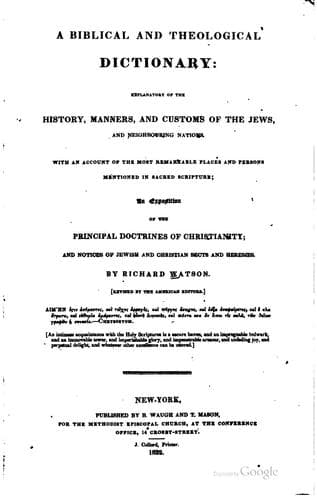
A Biblical and Theological Dictionary: explanatory of the history, manners, and customs of the Jews, and neighbouring nationsWatson, Richard
Religion
A Biblical and Theological Dictionary: explanatory of the history, manners, and customs of the Jews, and neighbouring nations
Watson, Richard
Bible -- Dictionaries; Theology -- Dictionaries
xiv, 22, the Apostle says, ‘Hast thou faith? have it
to thyself before God.’ The scope of his reasoning shows that nothing is
there meant by faith, but a conviction of the truth in regard to the
article of which he had been treating, namely, the equality of days and
meats, in point of sanctity, under the Gospel dispensation. The same is
evidently the meaning of the word, verse 23, ‘Whatsoever is not of
faith, is sin;’ where, without regard to the morality of an action
abstractly considered, that is concluded to be sin which is done by one
who doubts of its lawfulness. 2. As to spiritual gifts, prophecy and
inspiration in particular, they appear to have been accompanied with
such a faith or conviction that they came from the Spirit, as left no
room for hesitation. And indeed it is easy to perceive that something of
this kind was absolutely necessary to enable the inspired person to
distinguish what proceeded from the Spirit of God, from what was the
creature of his own imagination. The prophets of God were not acted upon
like machines in delivering their predictions, as the diviners were
supposed to be among the Heathen, but had then, as at other times, the
free use of their faculties, both of body and mind.” This caution is
therefore with great propriety given them by the Apostle, to induce them
to be attentive in prophesying, not to exceed the precise measure
allowed them, (for different measures of the same gift were committed to
different persons,) and not to mingle aught of their own with the things
of God’s Spirit. Let him prophesy according to the proportion in which
he has received this gift, which is in proportion to his faith. Though a
sense somewhat different has been given to the words by some ancient
Greek expositors, none of them seems to have formed a conception of that
sense, which, as was observed above, has been given by some moderns.
This has, nevertheless, a sound and sober principle included in it,
although capable of great abuse. Undoubtedly there is a class of great
and leading truths in the Scriptures so clearly revealed as to afford
principles of interpretation in doubtful passages, and these are so
obvious that persons of sound minds and hearts will not need those
formal rules for the application of the analogy of faith to
interpretation, which have been drawn up by several writers, and which
when not misleading, are generally superfluous.
Public-domain text, read in full here on John Shaqi.
Reviews
Reviews
No reviews yet
Be the first to share your thoughts on this work.
Elsewhere in the archive
Join the Discussion
Join the discussion
Sign in to leave a comment or review.
Sign InorCreate an account