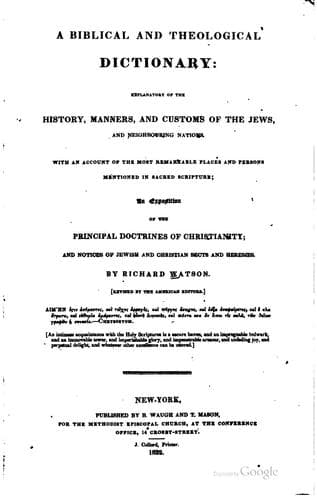
A Biblical and Theological Dictionary: explanatory of the history, manners, and customs of the Jews, and neighbouring nationsWatson, Richard
Religion
A Biblical and Theological Dictionary: explanatory of the history, manners, and customs of the Jews, and neighbouring nations
Watson, Richard
Bible -- Dictionaries; Theology -- Dictionaries
ANANIAS was the son of Nebedæus, high priest of the Jews. According to
Josephus, he succeeded Joseph, the son of Camith, in the forty-seventh
year of the Christian æra; and was himself succeeded by Ishmael, the son
of Tabæus, in the year 63. Quadratus, governor of Syria, coming into
Judæa, on the rumours which prevailed among the Samaritans and Jews,
sent the high priest Ananias to Rome, to vindicate his conduct to the
emperor. The high priest justified himself, was acquitted, and returned.
St. Paul being apprehended at Jerusalem by the tribune of the Roman
troops that guarded the temple, declared to him that he was a citizen of
Rome. This obliged the officer to treat him with some regard. As he was
ignorant of what the Jews accused him, the next day he convened the
priests, and placed St. Paul in the midst of them, that he might justify
himself. St. Paul began as follows: “Men and brethren, I have lived in
all good conscience before God until this day.” He had scarcely spoken
this, when the high priest, Ananias, commanded those who were near him
to smite him on the face. The Apostle immediately replied, “God shall
judge thee, thou whited wall; for, sittest thou to judge me after the
law, and commandest me to be smitten contrary to the law?” They that
stood by said, “Revilest thou God’s high priest?” And Paul answered, “I
wist not, brethren, that he was the high priest; for it is written, Thou
shalt not speak evil of the ruler of thy people,” Acts xxii, 23, 24;
xxiii, 1–5; by which words many suppose that the Apostle spake in bitter
irony; or at least that he considered Ananias as a usurper of the office
of the priesthood.
After this, the assembly being divided in opinion, St. Paul was sent by
the tribune to Cæsarea, that Felix, governor of the province, might take
cognizance of the affair. When it was known that the Apostle had arrived
at Cæsarea, Ananias the high priest, and other Jews, went thither to
accuse him; but the affair was adjourned, and St. Paul continued two
years in prison in that city, Acts xxiv.
Public-domain text, read in full here on John Shaqi.
Reviews
Reviews
No reviews yet
Be the first to share your thoughts on this work.
Elsewhere in the archive
Join the Discussion
Join the discussion
Sign in to leave a comment or review.
Sign InorCreate an account