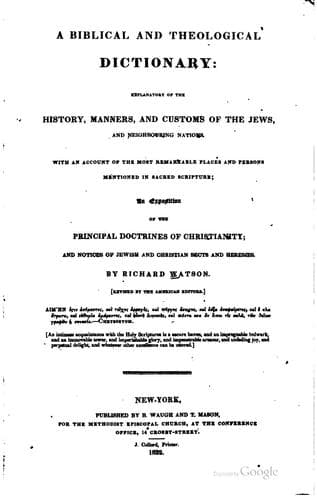
A Biblical and Theological Dictionary: explanatory of the history, manners, and customs of the Jews, and neighbouring nationsWatson, Richard
Religion
A Biblical and Theological Dictionary: explanatory of the history, manners, and customs of the Jews, and neighbouring nations
Watson, Richard
Bible -- Dictionaries; Theology -- Dictionaries
The Apostle’s prediction that God would smite Ananias, was thus
accomplished: Albinus, governor of Judæa, being come into that country,
Ananias found means to gain him by presents; and Ananias, by reason of
this patronage, was considered as the first man of his nation. However,
there were in his party some violent persons, who plundered the country,
and seized the tithes of the priests; and this they did with impunity,
on account of the great credit of Ananias. At the same time, several
companies of assassins infested Judæa, and committed great ravages. When
any of their companions fell into the hands of the governors of the
province, and were about to be executed, they failed not to seize some
domestic or relation of the high priest Ananias, that he might procure
the liberty of their associates, in exchange for those whom they
detained. Having taken Eleazer, one of Ananias’s sons, they did not
release him till ten of their companions were liberated. By this means
their number considerably increased, and the country was exposed to
their ravages. At length, Eleazer, the son of Ananias, heading a party
of mutineers, seized the temple, and forbade any sacrifices for the
emperor. Being joined by the assassins, he pulled down the house of his
father Ananias, with his brother, hid himself in the aqueducts belonging
to the royal palace, but was soon discovered, and both of them were
killed. Thus God smote this whited wall, in the very beginning of the
Jewish wars.
2. ANANIAS, one of the first Christians of Jerusalem, who being
converted, with his wife Sapphira, sold his estate; (as did the other
Christians at Jerusalem, under a temporary regulation that they were to
have all things in common;) but privately reserved a part of the
purchase money to himself. Having brought the remainder to St. Peter, as
the whole price of the inheritance sold, the Apostle, to whom the Holy
Ghost had revealed this falsehood, rebuked him severely, as having lied
not unto men but unto God, Acts v. At that instant, Ananias, being
struck dead, fell down at the Apostle’s feet; and in the course of three
hours after, his wife suffered a similar punishment. This happened, A.
D. 33, or 34. It is evident, that in this and similar events, the
spectators and civil magistrates must have been convinced that some
extraordinary power was exerted; for if Peter had himself slain Ananias,
he would have been amenable to the laws as a murderer. But, if by
forewarning him that he should immediately die, and the prediction came
to pass, it is evident that the power which attended this word of Peter
was not from Peter, but from God. This was made the more certain by the
death of two persons, in the same manner, and under the same
circumstances, which could not be attributed to accident.
Public-domain text, read in full here on John Shaqi.
Reviews
Reviews
No reviews yet
Be the first to share your thoughts on this work.
Elsewhere in the archive
Join the Discussion
Join the discussion
Sign in to leave a comment or review.
Sign InorCreate an account