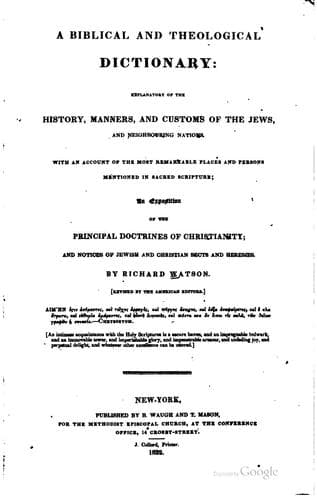
A Biblical and Theological Dictionary: explanatory of the history, manners, and customs of the Jews, and neighbouring nationsWatson, Richard
Religion
A Biblical and Theological Dictionary: explanatory of the history, manners, and customs of the Jews, and neighbouring nations
Watson, Richard
Bible -- Dictionaries; Theology -- Dictionaries
3. _Ananias_, a disciple of Christ, at Damascus, whom the Lord directed
to visit Paul, then lately converted. Ananias answered, “Lord, I have
heard by many of this man, how much evil he hath done to thy saints at
Jerusalem; and how he hath authority from the chief priests to bind all
that call upon thy name.” But the Lord said unto him, “Go thy way, for
he is a chosen vessel unto me.” Ananias, therefore, went to the house in
which God had revealed unto him that Paul was, and putting his hands on
him, said, “Brother Saul, the Lord Jesus who appeared unto thee in the
way, hath sent me that thou mightest receive thy sight, and be filled
with the Holy Ghost,” Acts ix, 10–12, &c. We are not informed of any
other circumstance of the life of Ananias.
ANATHEMA, from ἀνατίθημι, signifies something set apart, separated, or
devoted, Mic. iv, 13, or the _formula_ by which this is effected. To
anathematize is generally understood to denote the cutting off or
separating any one from the communion of the faithful, the number of the
living, or the privileges of society; or the devoting of an animal,
city, or other thing, to destruction. See ACCURSED.
ANATHEMA MARANATHA. “If any man love not the Lord Jesus Christ, let him
be Anathema Maranatha,” 1 Cor. xvi, 22. Why these two words, one Greek
and the other Syriac, were not translated, is not obvious. They are the
words with which the Jews began their greater excommunication, whereby
they not only excluded sinners from their society, but delivered them up
to the divine _cherem_, or anathema, that is, to misery in this life,
and perdition in the life to come. “Let him be Anathema” is, “Let him be
accursed.” Maranatha signifies, “The Lord cometh,” or, “will come;” that
is, to take vengeance. See See ACCURSED.
ANDREW, an Apostle of Jesus Christ, a native of Bethsaida, and the
brother of Peter. He was at first a disciple of John the Baptist, whom
he left to follow our Saviour, after the testimony of John, “Behold the
Lamb of God which taketh away the sin of the world,” John i, 29, and was
the first disciple received by our Saviour. Andrew then introduced his
brother Simon, and they went with him to the marriage in Cana, but
afterward returned to their ordinary occupation, not expecting, perhaps,
to be farther employed in his service. However, some months after, Jesus
meeting them, while fishing together, called them to a regular
attendance upon him, and promised to make them fishers of men, Matt. iv,
19.
Public-domain text, read in full here on John Shaqi.
Reviews
Reviews
No reviews yet
Be the first to share your thoughts on this work.
Elsewhere in the archive
Join the Discussion
Join the discussion
Sign in to leave a comment or review.
Sign InorCreate an account