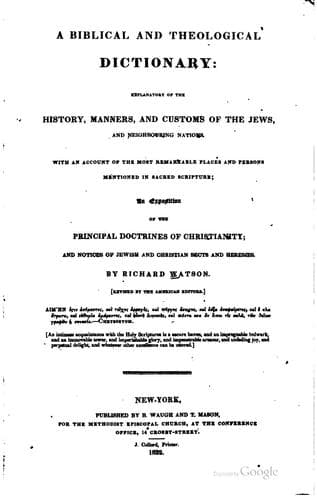
A Biblical and Theological Dictionary: explanatory of the history, manners, and customs of the Jews, and neighbouring nationsWatson, Richard
Religion
A Biblical and Theological Dictionary: explanatory of the history, manners, and customs of the Jews, and neighbouring nations
Watson, Richard
Bible -- Dictionaries; Theology -- Dictionaries
After our Saviour’s ascension, tradition states that Andrew was
appointed to preach in Scythia and the neighbouring countries. According
to Eusebius, after this Apostle had planted the Gospel in several
places, he came to Patræ, in Achaia, where, endeavouring to convert the
pro-consul Ægeas, he was, by that governor’s orders, first scourged, and
then crucified. The time of his suffering martyrdom is not known; but
all the ancient and modern martyrologies of the Greeks and Latins agree
in celebrating his festival on the 30th of November. His body was
embalmed, and decently interred at Patræ, by Maximilla, a lady of great
quality and estate. It was afterward removed to Constantinople, by
Constantine the Great, who buried it in the great church which he had
built to the honour of the Apostles. It is not known for what reason
painters represent St. Andrew’s cross like an X. Peter Chrysologus says
that he was crucified upon a tree; and the spurious Hippolytus assures
us that it was an olive tree. Nevertheless, the tradition which
describes him to have been nailed to a cross is very ancient.
ANGEL, a spiritual, intelligent substance, the first in rank and dignity
among created beings. The word angel, ἀγγέλος, is not properly a
denomination of nature but of office; denoting as much as _nuncius_,
messenger, a person employed to carry one’s orders, or declare his will.
Thus it is St. Paul represents angels, Heb. i, 14, where he calls them
“ministering spirits;” and yet custom has prevailed so much, that angel
is now commonly taken for the denomination of a particular order of
spiritual beings, of great understanding and power, superior to the
souls or spirits of men. Some of these are spoken of in Scripture in
such a manner as plainly to signify that they are real beings, of a
spiritual nature, of high power, perfection, dignity, and happiness.
Others of them are distinguished as not having kept their first station,
Jude 6. These are represented as evil spirits, enemies of God, and
intent on mischief. The devil as the head of them, and they as his
angels, are represented as the rulers of the darkness of this world, or
spiritual wickednesses, or wicked spirits, τὰ ϖνευματικὰ τῆς ϖονηρίας ἐν
τοῖς ἐπȣρανίοις, Eph. vi, 12; which may not be unfitly rendered, “the
spiritual managers of opposition to the kingdom of God.”
Public-domain text, read in full here on John Shaqi.
Reviews
Reviews
No reviews yet
Be the first to share your thoughts on this work.
Elsewhere in the archive
Join the Discussion
Join the discussion
Sign in to leave a comment or review.
Sign InorCreate an account