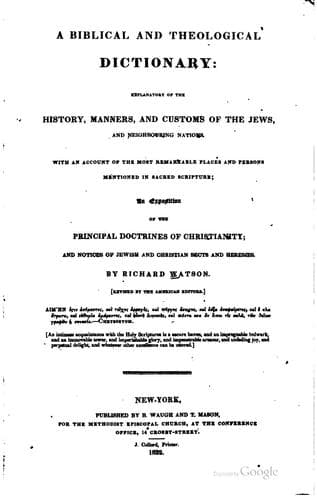
A Biblical and Theological Dictionary: explanatory of the history, manners, and customs of the Jews, and neighbouring nationsWatson, Richard
Religion
A Biblical and Theological Dictionary: explanatory of the history, manners, and customs of the Jews, and neighbouring nations
Watson, Richard
Bible -- Dictionaries; Theology -- Dictionaries
The existence of angels is supposed in all religions, though it is
incapable of being proved _a priori_. Indeed, the ancient Sadducees are
represented as denying all spirits; and yet the Samaritans, and
Caraites, who are reputed Sadducees, openly allowed them: witness
Abusaid, the author of an Arabic version of the Pentateuch; and Aaron, a
Caraite Jew, in his comment on the Pentateuch; both extant in manuscript
in the king of France’s library. In the Alcoran we find frequent mention
of angels. The Mussulmen believe them of different orders or degrees,
and to be destined for different employments both in heaven and on
earth. They attribute exceedingly great power to the angel Gabriel, as
that he is able to descend in the space of an hour from heaven to earth;
to overturn a mountain with a single feather of his wing, &c. The angel
Asrael, they suppose, is appointed to take the souls of such as die; and
another angel, named Esraphil, they tell us, stands with a trumpet ready
in his mouth to proclaim the day of judgment.
The Heathen philosophers and poets were also agreed as to the existence
of intelligent beings, superior to man; as is shown by St. Cyprian in
his treatise of the vanity of idols; from the testimonies of Plato,
Socrates, Trismegistus, &c. They were acknowledged under different
appellations; the Greeks calling them dæmons, and the Romans genii, or
lares. Epicurus seems to have been the only one among the old
philosophers who absolutely rejected them.
Authors are not so unanimous about the nature as about the existence of
angels. Clemens Alexandrinus believed they had bodies; which was also
the opinion of Origen, Cæsarius, Tertullian, and several others.
Athanasius, St. Basil, St. Gregory Nicene, St. Cyril, St. Chrysostom,
&c, held them to be mere spirits. It has been the more current opinion,
especially in later times, that they are substances entirely spiritual,
who can, at any time, assume bodies, and appear in human or other
shapes. Ecclesiastical writers make a hierarchy of nine orders of
angels. Others have distributed angels into nine orders, according to
the names by which they are called in Scripture, and reduced these
orders into three hierarchies; to the first of which belong seraphim,
cherubim, and thrones; to the second, dominions, virtues, and powers;
and to the third, principalities, archangels, and angels. The Jews
reckon four orders or companies of angels, each headed by an archangel;
the first order being that of Michael; the second, of Gabriel; the
third, of Uriel; and the fourth, of Raphael. Following the Scripture
account, we shall find mention made of different orders of these
superior beings; for such a distinction of orders seems intimated in the
names given to different classes. Thus we have _thrones_, _dominions_,
_principalities_, or princedoms, _powers_, _authorities_, _living ones_,
_cherubim_, and _seraphim_. That some of these titles may indicate the
Public-domain text, read in full here on John Shaqi.
Reviews
Reviews
No reviews yet
Be the first to share your thoughts on this work.
Elsewhere in the archive
Join the Discussion
Join the discussion
Sign in to leave a comment or review.
Sign InorCreate an account